

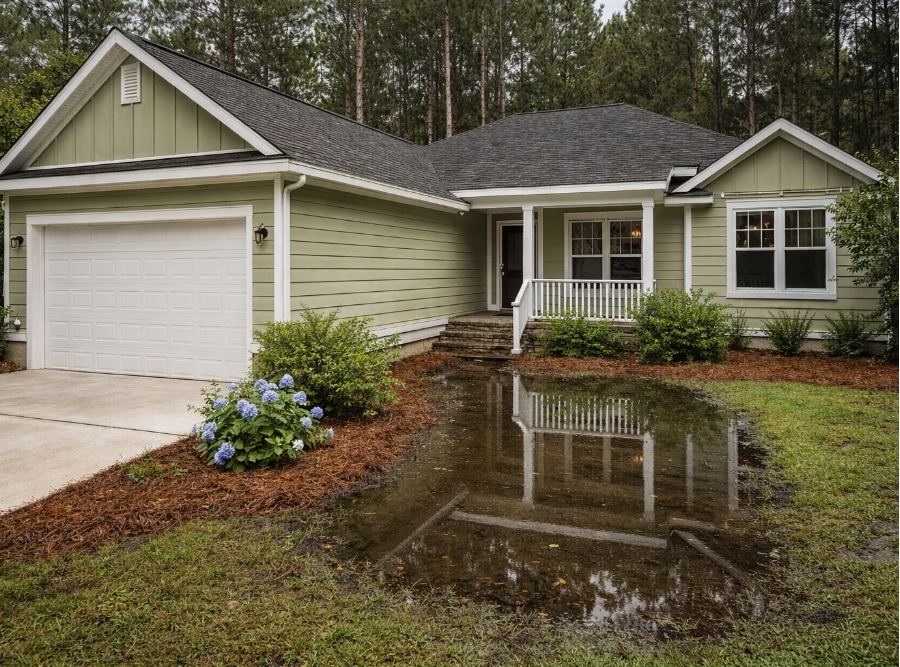
Drainage Problems Homeowners Overlook
Drainage problems are one of the most overlooked causes of long-term home damage. Most homeowners only notice them after water starts pooling, soil begins to shift, or moisture shows up where it should not.
What many people do not realize is that poor drainage affects far more than just landscaping. It can lead to foundation stress, soil erosion, moisture intrusion, and even issues with systems like garage doors that sit at ground level.
In most cases, these problems can be traced back to a few common but often ignored causes. Gutters that are clogged or improperly pitched, downspouts that do not carry water far enough away, poor grading around the home, and repeated exposure to excess moisture all contribute to a breakdown in how water is managed. Understanding how these factors connect is the key to preventing damage before it becomes expensive.
The Problem Starts at the Roofline
Proper drainage begins at the top of the home. Gutters and downspouts are designed to collect rainwater and direct it away before it has a chance to cause damage.
When gutters are clogged, undersized, or improperly angled, water does not move as intended. Instead of being carried away, it spills over the edges, runs down exterior walls, and collects at the base of the home. Over time, this repeated exposure changes how water behaves around the structure.
This is why proper gutter installation and water management are critical, especially in areas like Bluffton and other regions that experience heavy rainfall and humidity. When water is not directed away effectively, it does not disappear. It accumulates near the foundation, alters soil conditions, and begins to affect nearby structures, including the garage.
At that point, drainage is no longer just a surface issue. It becomes a structural concern.
Foundation Saturation Is Often the First Warning Sign
One of the earliest and most important signs of poor drainage is water buildup around the foundation.
As soil becomes saturated, it expands and shifts. This creates pressure against foundation walls, which can eventually lead to cracks, settling, or moisture intrusion. These changes often happen gradually, making them easy to overlook until more noticeable damage appears.
In areas like Bluffton and other regions that experience heavy rainfall and humidity, water does not always drain quickly. This allows saturation to linger longer than expected, increasing the likelihood of long-term issues.
At this stage, the problem extends beyond standing water. It begins to affect the structural stability of the home itself.
Soil Erosion Changes the Entire System
Poor drainage does not just create water buildup. It changes the landscape in ways that reinforce the problem.
As water repeatedly flows in the wrong direction, it begins to reshape the ground. Soil erodes, low areas form, and natural drainage paths are disrupted. Once these patterns are established, water continues to follow them, often bringing it closer to the home with each rainfall.
What may begin as a minor overflow issue can gradually develop into a consistent drainage pattern that becomes more difficult to correct over time.
How Poor Drainage Affects Garage Doors
Garage doors are especially vulnerable to drainage issues because they sit at ground level, where water naturally collects.
When water pools near the base of the garage, it can lead to moisture intrusion, swelling of materials, and long-term wear on seals and hardware. Over time, this exposure affects how the door opens, closes, and protects the interior of the space.
We see a lot of ‘ghost’ issues where sensors fail, or openers struggle to find their limit,” says Maxim Geht of Ohio Garage Door Repair, located in Twinsburg, OH. “Homeowners think it’s an electronic glitch, but it’s often humidity rising from pooled water right at the threshold because the downspouts are discharging too close to the door. You can’t fix an electronic sensor if the environmental drainage is constantly tripping it.
This is where many homeowners misdiagnose the issue. What appears to be a failing garage system is often a symptom of a larger drainage problem.
When Water Problems Become System Problems
Drainage does not exist in isolation. It influences how multiple systems in your home perform.
Moisture buildup around the garage can contribute to corrosion, sensor inconsistencies, and structural wear. In the field, teams like Ohio Garage Door Repair often find that a seemingly broken opener is actually the result of long-term exposure to excess moisture rather than a true mechanical failure, especially in homes where drainage issues have gone unnoticed.
It is not uncommon for a homeowner to replace an opener, only to experience the same issue weeks later because the underlying drainage problem was never addressed.
At this point, the issue is no longer about a single component. It is about how water is affecting the entire system.
Downspouts and Water Direction
Even when gutters are functioning properly, problems can still occur if water is not carried far enough away from the home.
Downspouts that discharge too close to the foundation allow water to cycle back into the same problem areas. Over time, this repeated exposure leads to saturation and erosion similar to what happens with overflowing gutters.
In many cases, extending downspouts or redirecting water flow is a simple adjustment that can significantly improve overall drainage.
Grading and the Bigger Picture
The slope of the ground around your home plays a major role in how water moves.
Ideally, the soil should guide water away from the structure. When grading is flat or slopes toward the home, water naturally collects where it should not. This is especially common in properties where landscaping has been added or altered without considering drainage patterns.
Even small grading issues can have a meaningful impact over time, particularly during periods of heavy rainfall.
A System, Not a Single Fix
One of the most common misunderstandings about drainage is the idea that it can be solved with a single improvement.
In reality, effective drainage depends on multiple elements working together. Gutters, downspouts, grading, and surrounding surfaces all play a role in directing water safely away from the home. When one part of that system fails, the effects extend further than expected.
A More Preventive Approach
The most effective way to manage drainage is to address it before visible problems appear.
Regular gutter maintenance, proper water redirection, and an understanding of how water moves across your property can prevent many of the issues homeowners face later on. In many cases, early adjustments are far less costly than repairing damage after it has already occurred.
Drainage Problems Do Not Stay in One Place
Drainage issues rarely stay confined to one area. What begins at the roofline can eventually affect the foundation, landscaping, and even garage systems.
When you understand how these elements are connected, you are in a much better position to catch small issues early, avoid unnecessary repairs, and protect your home over the long term

Helder is the owner of GutterXperts, a family-owned seamless gutter company serving Bluffton, Hardeeville, Hilton Head Island, and the surrounding Lowcountry. He personally inspects every completed installation, and the team fabricates each gutter run on-site to match the exact roofline rather than using pre-cut sections. GutterXperts is licensed in South Carolina and Georgia and has served more than 500 homes throughout the region.