

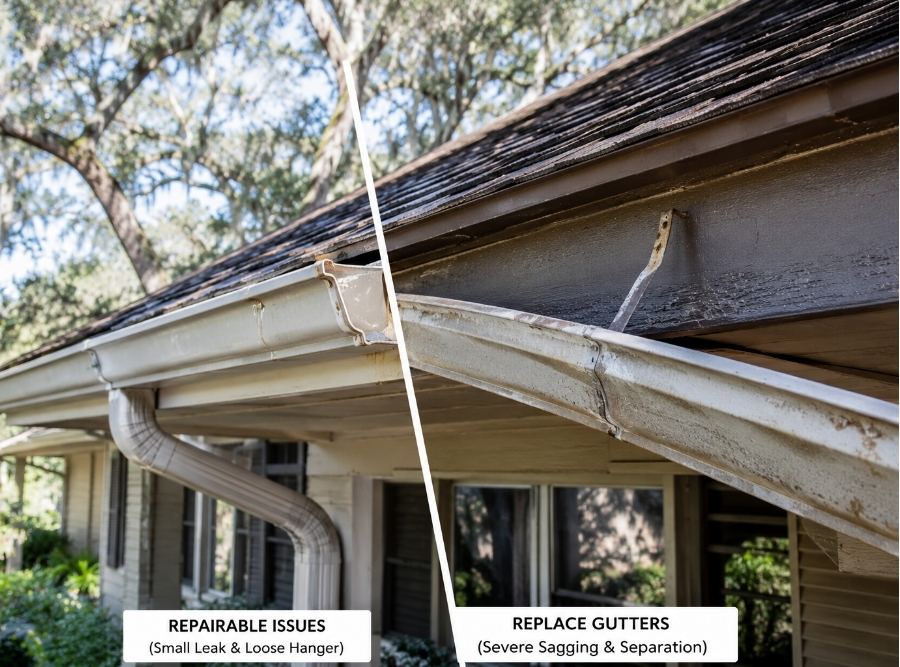
How Do You Know If Gutters Need Repair or Full Replacement?
Gutters can often be repaired when the problem is limited to a few leaks, loose hangers, or isolated sections. However, if you’re dealing with widespread sagging, recurring leaks, gutters pulling away from the house, extensive rust or corrosion, or repeated repairs that never seem to solve the problem, full replacement is usually the more practical long-term solution.
Most homeowners don’t spend much time thinking about their gutters until something goes wrong. A small leak appears at a corner. Water starts dripping behind the gutter during a storm. A section begins pulling away from the house. At first, the issue seems minor. Many homeowners assume a quick repair will solve the problem.
Sometimes they’re right.
Other times, the visible issue is simply the first sign of a system that has been slowly deteriorating for years. This is particularly common on Hilton Head Island, where gutters are exposed to salt-laden air, year-round humidity, tropical storms, intense summer rainfall, and hurricane-season winds. Those environmental factors place constant stress on gutter systems, attachment points, and the wood structures supporting them.
The challenge for homeowners is determining whether they’re looking at a repairable problem or a gutter system that has reached the end of its useful life.
The Difference Between a Repair Problem and a System Problem
One of the biggest mistakes homeowners make is focusing only on the symptom they can see. A leak at a corner, for example, may look like a simple sealing issue. In reality, that leak could be the result of years of expansion and contraction stress, movement within the gutter system, or deterioration elsewhere along the run.
A repair generally makes sense when the problem is isolated. A loose downspout, a failed hanger, a minor seam leak, or a small section damaged by a storm can often be corrected without replacing the entire system. When the rest of the gutters remain structurally sound, repairing the affected area is usually the most cost-effective approach.
Replacement becomes a more serious consideration when multiple components are failing simultaneously. If the gutters leak in several locations, sag along multiple sections, repeatedly pull away from the fascia, and continue causing drainage problems despite previous repairs, the issue is no longer isolated. At that point, the homeowner is dealing with system-wide deterioration rather than a single repair need.
Understanding this distinction is often the first step toward making a smart long-term decision.
Warning Signs That Repairs May Still Be Enough
Not every gutter issue requires replacement. In fact, many homeowners are surprised to learn that certain problems can be corrected relatively easily when addressed early.
A recently developed leak at a seam, a loose hanger after a storm, or a section that has lost proper pitch can often be repaired successfully. These types of issues typically involve a specific component rather than widespread deterioration throughout the system.
One pattern we frequently see throughout Hilton Head neighborhoods such as Palmetto Dunes, Indigo Run, Hilton Head Plantation, and Shipyard is minor storm-related damage. A strong wind event may loosen a hanger or shift a section of gutter without affecting the overall integrity of the system. In these situations, targeted repairs often restore proper performance without requiring extensive work.
The key factor is whether the repair addresses the root cause of the problem. A properly executed repair should solve the issue rather than simply hide it for a few months.
When repairs become routine instead of occasional, the conversation usually changes.
When Replacement Starts Making More Sense
One of the clearest indicators that replacement should be considered is the presence of multiple recurring issues across the system.
Homeowners often reach this stage gradually. First, a corner leaks. Then another section begins sagging. A few years later, fasteners loosen. Water starts running behind the gutters during storms. The problems seem unrelated until a professional inspection reveals that they are all symptoms of a larger structural decline.
We frequently hear homeowners say things like, “I’ve repaired this three times already,” or “Every storm seems to create a new problem.” Those statements are often signs that the gutter system is no longer delivering reliable performance.
Age can also become a factor. While lifespan varies significantly depending on material quality, installation standards, maintenance history, and environmental exposure, older systems often develop multiple failures at once. Years of rainfall, humidity, expansion cycles, debris accumulation, and coastal exposure gradually weaken seams, attachment points, and structural connections.
At some point, replacing individual components becomes less practical than investing in a properly designed system that addresses all of the underlying issues at once.
Why Gutters Pull Away From the House
Few gutter problems create more concern than seeing a section visibly separating from the home.
When homeowners notice gutters pulling away from the fascia, they often assume the fasteners have simply loosened. Sometimes that’s true. However, the real cause is often more complicated.
Years of water exposure can weaken fascia boards hidden behind the gutter. Moisture intrusion, repeated overflow, and long-term humidity can gradually compromise the wood structure supporting the system. In those situations, reinstalling the gutter without addressing the fascia simply creates a temporary fix.
One of the most common inspection findings on Hilton Head homes is a combination of gutter and fascia deterioration occurring simultaneously. The homeowner focuses on the loose gutter because it’s visible, while the actual structural problem remains hidden behind it.
This is why professional evaluations look beyond the gutter itself. A successful repair or replacement decision depends on understanding the condition of the supporting structure as well.
What We Commonly See on Hilton Head Homes
The island’s environment creates a unique set of challenges that influence how gutter systems age.
Homes in Sea Pines, Forest Beach, Port Royal Plantation, and other areas closer to coastal exposure often experience accelerated wear due to salt air and constant humidity. Metal components can deteriorate more quickly, attachment systems experience greater stress, and repeated storm activity can gradually loosen structural connections.
One of the most common situations we encounter involves homeowners who believe their gutters simply need cleaning because they are overflowing during rainstorms. After inspection, the gutters are often relatively clear. The real issue is sagging sections, improper pitch, attachment failure, or structural deterioration that prevents water from flowing correctly toward the downspouts.
Another common scenario involves homes that have received multiple repairs over many years. Individual fixes may have been reasonable at the time, but eventually the collection of aging sections, mismatched repairs, and recurring leaks creates a system that is increasingly difficult to maintain efficiently.
These situations rarely develop overnight. They are usually the result of gradual deterioration that has been building for years.
The Most Expensive Mistake Homeowners Make
The most expensive gutter problems are rarely caused by the gutters themselves.
The real cost often comes from what happens after a failing gutter system is ignored. Water begins reaching fascia boards. Soffits remain wet for extended periods. Landscaping washes away during storms. Moisture accumulates near the foundation. Hidden wood rot develops. In some cases, mold growth and exterior carpentry repairs become necessary.
One of the biggest misconceptions homeowners have is that a gutter problem remains a gutter problem. In reality, gutters are part of a larger water-management system designed to protect the home. When that system stops functioning properly, the effects often extend far beyond the gutter itself.
This is why delaying an inspection can sometimes turn a relatively straightforward repair into a much larger project.
The Real Question Isn’t Repair or Replacement
Many homeowners begin by asking whether their gutters need repair or replacement. While that seems like the logical question, it isn’t always the most important one.
A better question is whether the current system is still capable of protecting the home effectively.
A repaired gutter that continues managing water properly may provide many additional years of service. A heavily patched system with recurring leaks, sagging sections, and ongoing drainage problems may continue generating repair bills without ever solving the underlying issue.
The goal should never be repairing gutters for the sake of repairing them. The goal is maintaining a drainage system that reliably protects the home’s roofline, fascia, siding, landscaping, and foundation through years of Hilton Head’s coastal weather.
If you’re seeing recurring leaks, sagging sections, gutters pulling away from the house, or overflow problems that seem to return every rainy season, a professional inspection can help determine whether a targeted repair is still practical or whether replacement offers the better long-term investment. In many cases, understanding the condition of the entire system—not just the visible symptom is what ultimately leads to the right decision.

Helder is the owner of GutterXperts, a family-owned seamless gutter company serving Bluffton, Hardeeville, Hilton Head Island, and the surrounding Lowcountry. He personally inspects every completed installation, and the team fabricates each gutter run on-site to match the exact roofline rather than using pre-cut sections. GutterXperts is licensed in South Carolina and Georgia and has served more than 500 homes throughout the region.