

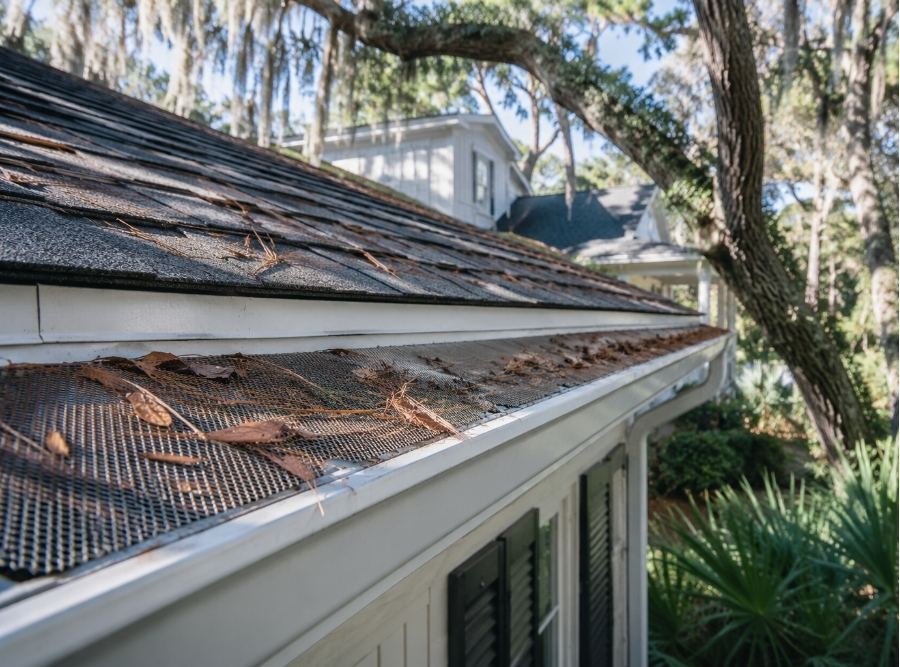
What Type of Gutter Guards Actually Work With Pine Needles and Live Oak Debris in Hilton Head?
The gutter guards that usually work best with pine needles and live oak debris in Hilton Head are high-quality micro-mesh gutter guards installed over a properly cleaned, properly pitched gutter system. They can greatly reduce debris intrusion, but no gutter guard is truly maintenance-free in Hilton Head’s tree-heavy, humid, coastal environment.
Pine needles and live oak debris create one of the hardest gutter protection problems on Hilton Head Island. A gutter guard that works well in a neighborhood with broad maple leaves or light seasonal debris may struggle badly under longleaf pine straw, live oak leaves, oak tassels, acorns, pollen, and fine organic material. That is why many homeowners install gutter guards expecting relief, only to find pine needles sitting on top of the guards, water running over the front edge, or gutters clogging again after a few seasons.
The issue is not always that gutter guards do not work. More often, the wrong type of guard was installed for the local debris load, the existing gutters were not cleaned before installation, the roof valleys concentrate too much water into one area, or the homeowner was told to expect “maintenance-free” performance in an environment where that promise is not realistic. On Hilton Head, especially in areas like Sea Pines, Palmetto Dunes, Hilton Head Plantation, Shipyard, Port Royal Plantation, and Long Cove, mature trees are not occasional landscaping features. They are part of the environment the gutter system has to manage every day.
The best gutter guard for Hilton Head is not simply the one with the strongest marketing claim. It is the one that can block fine debris, allow heavy rain to enter the gutter, shed pine straw reasonably well, resist sagging, and remain serviceable over time. Even then, it should be viewed as a maintenance-reducing system, not a maintenance-eliminating system.
Why Pine Needles and Live Oak Debris Are So Difficult
Pine needles create a very different problem from ordinary leaves. A large leaf may land on a gutter cover, dry out, and eventually blow away. Pine needles are thin, flexible, and capable of finding small openings in many lower-quality screens and perforated covers. Even when they do not enter the gutter, they can collect across the surface of the guard and form a dense mat that slows water entry during rain.
Live oak debris adds another layer of difficulty. Hilton Head’s live oaks drop leaves, tassels, acorns, small twigs, and organic particles that break down quickly in coastal humidity. When this material mixes with pine straw, pollen, roof grit, and moisture, it can create a sticky layer on top of the gutter guard. That layer may not look serious at first, but during a heavy thunderstorm it can reduce how quickly water passes through the guard and into the gutter.
This is why homeowners often say, “My gutter guards are clogged,” even when the gutter trough underneath is not packed with debris. The clog may be happening on the surface of the guard rather than inside the gutter. Water does not care whether the restriction is inside the gutter or on top of the guard. If it cannot enter the system fast enough, it will overflow, overshoot, or run behind the gutter.
Hilton Head’s climate makes the problem worse because debris stays damp longer. Humidity, shade from tree canopies, frequent thunderstorms, and salt-air exposure all contribute to slower drying times. In older neighborhoods with mature live oaks and pines, surface debris can become more persistent than homeowners expect, especially on shaded rooflines and valleys where water and debris repeatedly collect.
Why Some Gutter Guards Fail Under Hilton Head Tree Cover
Many gutter guards fail because they were designed for general leaf protection rather than fine debris control. Wide-hole screens, basic plastic inserts, and low-cost perforated covers may stop large leaves, but they often allow pine needles, oak tassels, roof grit, and small organic material to enter the gutter. Once that debris gets inside, it can move toward downspouts, collect at elbows, and create hidden drainage restrictions.
Reverse-curve and surface-tension covers can also struggle in Hilton Head conditions. These systems are designed to guide water around a curved surface while shedding debris over the edge. The concept can work in some settings, but pine needles and live oak debris often interfere with the water path. When debris mats form along the front edge, water can overshoot the gutter entirely, especially during heavy rain or where roof valleys send concentrated runoff into one section.
Cheap screen guards often create another problem. They may sag under debris loads, separate at seams, or allow gaps where pine needles enter. Once debris begins collecting at those weak points, the system gradually becomes less effective. Homeowners may still have gutter guards installed, but the system performs almost like an unprotected gutter because water and debris are no longer being managed correctly.
One of the most common misunderstandings is that any guard is better than no guard. In some environments, that may be true. On Hilton Head, the wrong guard can actually make maintenance more frustrating because it hides the debris problem until overflow becomes obvious. A poor guard can trap material, slow water entry, make cleaning harder, and give homeowners a false sense of security.
Why Micro-Mesh Is Usually the Best Fit
For homes dealing with pine needles and live oak debris, high-quality micro-mesh gutter guards are usually the strongest option. The fine mesh is designed to block small debris before it enters the gutter trough, which is especially important in areas with pine straw, oak tassels, acorns, pollen, and roof grit. Unlike wide-hole screens, micro-mesh systems are built to manage smaller particles that commonly defeat basic gutter covers.
The key advantage is filtration. Micro-mesh allows water to enter the gutter while keeping most debris on the surface where it can dry, loosen, and eventually blow away or be removed during routine maintenance. This can significantly reduce downspout clogs and heavy interior gutter cleanouts, which are two of the biggest problems for homes under mature trees.
However, micro-mesh is not magic. If a home sits directly beneath heavy pine canopy or live oak cover, debris will still land on the guard. Some of it may stay there, especially in shaded or damp areas. During light rain, water may pass through without issue. During a hard Hilton Head thunderstorm, a surface loaded with pine needles and decomposed organic material may slow the water enough to cause temporary overflow.
That does not mean micro-mesh failed. It means the system is working in a difficult environment and still needs periodic attention. The best micro-mesh systems reduce debris intrusion and make maintenance easier, but they do not erase the reality of Hilton Head’s tree cover, humidity, and storm intensity.
The Biggest Misconception About Gutter Guards
The biggest misconception is that gutter guards eliminate cleaning forever. That expectation causes a lot of frustration because homeowners believe any visible debris or overflow means the product failed. In reality, the purpose of a good gutter guard is to reduce gutter cleaning, reduce interior clogs, and help the system manage debris more effectively. It is not to make the roofline self-cleaning.
This distinction matters on Hilton Head because the debris load is unusually persistent. Live oaks drop material through multiple seasons. Pine trees shed needles throughout the year. Storms blow debris across the roof from neighboring trees. Coastal humidity helps organic material break down into smaller particles that collect on surfaces. A guard that reduces 80 or 90 percent of interior gutter debris can still require occasional surface cleaning in this environment.
During inspections, one of the most common things we see is a homeowner who expected zero maintenance and then became disappointed when pine straw collected on top of the guards. In many cases, the gutters underneath are much cleaner than they would have been without protection. The issue is not that the guard is doing nothing; it is that the homeowner was promised the wrong result.
A better expectation is this: the right gutter guard should reduce cleaning frequency, reduce downspout clogs, make maintenance safer and more manageable, and help prevent serious water management problems. It should not be sold as a system that never needs inspection, especially on homes surrounded by mature pines and live oaks.
What We Commonly See on Hilton Head Homes
On Hilton Head, gutter guard performance often varies from one side of a house to another. A sunny elevation with good airflow may shed debris fairly well, while a shaded roofline under live oaks may hold damp organic material for weeks. A gutter run beneath a simple roof edge may perform well, while a section under a roof valley may overflow because too much water and debris are concentrated into one point.
In neighborhoods like Sea Pines, Shipyard, Port Royal Plantation, and Hilton Head Plantation, many homes sit under mature tree canopies that produce constant debris. These properties usually need higher-quality protection than open-lot homes in newer or less wooded areas. A basic screen may look appealing at first because it is inexpensive, but it often cannot handle the mix of pine straw, oak leaves, tassels, and fine organic debris common on the island.
We also see issues on vacation homes and rental properties because they may go longer between inspections. A full-time homeowner may notice slow drainage or surface debris after a storm. A seasonal owner may not see the problem until overflow has stained siding, washed out landscaping, or created water near an entryway. For these properties, the goal is often not just convenience but reducing the risk of unnoticed drainage failure.
Another common finding is that the existing gutters were never prepared properly before guards were installed. If guards are placed over gutters that already have debris, poor pitch, loose hangers, or downspout restrictions, the guard will not solve the underlying problem. Gutter protection should be installed as part of a working drainage system, not as a cover over an existing issue.
Roof Valleys, Heavy Rain, and Water Overshoot
Even the best gutter guard can struggle where roof valleys discharge concentrated water. A valley collects runoff from two roof planes and sends it into one area. During a heavy Hilton Head thunderstorm, that section of gutter may receive far more water than the rest of the roofline. If pine needles or live oak debris are sitting on top of the guard at that location, the water may not enter quickly enough and can overshoot the gutter.
This is one reason homeowners sometimes report that only one section overflows. The rest of the gutter system may perform properly, but the valley area becomes overloaded. In that situation, replacing the guard alone may not solve the issue. The system may need improved gutter pitch, larger capacity, better downspout placement, a different guard design in that section, or a drainage adjustment that accounts for the volume of water coming off the roof.
Water overshoot is often misdiagnosed as a clogged gutter. The homeowner sees water pouring over the front and assumes the trough is packed. Sometimes it is. But in many cases, the water is simply moving too fast across a debris-loaded guard surface. The issue is not just debris; it is the interaction between debris, roof design, rainfall intensity, and the guard’s water entry rate.
This is why product selection alone is not enough. A good gutter guard has to be matched with the home’s roof geometry, tree cover, gutter size, downspout layout, and local storm conditions. Hilton Head homes with complex rooflines need a system designed for runoff behavior, not just leaf blocking.
What Type of Guard Should Most Hilton Head Homeowners Avoid?
Most Hilton Head homeowners should be cautious with large-opening screens, flimsy plastic guards, foam inserts, and low-cost covers that are not designed for fine debris. These products may work temporarily in light debris environments, but they often struggle with pine needles and live oak material. Pine straw can slip through larger openings, oak tassels can mat across the surface, and foam-style products can trap organic debris in ways that become difficult to clean.
Surface-tension guards may be worth evaluating carefully, but they are not always ideal beneath heavy pine and oak cover. Their performance depends heavily on roof pitch, water flow, debris behavior, and installation details. When debris collects along the front edge or water comes off the roof too quickly, overflow can still occur.
The products most likely to disappoint homeowners are the ones marketed as “maintenance-free” without considering the local environment. Hilton Head is not a light-debris market. Homes beneath live oaks and pines need a system that can manage fine organic material, resist sagging, stay attached in coastal conditions, and be cleaned or serviced when necessary.
A gutter guard should never make maintenance harder than it needs to be. If the system traps debris, blocks access, or hides problems until overflow occurs, it may create more frustration than value.
Our Recommendation for Hilton Head Tree Debris
For most Hilton Head homes dealing with pine needles and live oak debris, a quality micro-mesh gutter guard is usually the best starting point. It offers the strongest combination of fine-debris filtration, downspout protection, and long-term performance when installed over a properly functioning gutter system. The material quality, frame strength, fastener durability, and installation method all matter because coastal humidity and salt air can wear down cheaper components faster than homeowners expect.
The recommendation changes slightly depending on the property. A heavily wooded home in Sea Pines or Port Royal Plantation may still need periodic surface cleaning even with micro-mesh. A rental home near Forest Beach may benefit from scheduled inspections because overflow may not be noticed right away. A more open property in Indigo Run or parts of Hilton Head Plantation may experience far less debris and require less maintenance overall.
The best gutter guard is not the one that promises the least cleaning. It is the one that matches the debris type, roof design, rainfall patterns, and maintenance expectations of the home. In Hilton Head, that usually means choosing a durable micro-mesh system, making sure the gutters and downspouts are working before installation, and accepting that seasonal inspection is still part of responsible home care.
The Guard Is Only as Good as the Drainage System Beneath It
Gutter guards are valuable, but they are not a substitute for a well-designed gutter system. If the gutters are undersized, poorly pitched, sagging, clogged, or served by too few downspouts, guards will not fix the drainage problem. They may reduce debris entering the system, but they cannot correct water that has nowhere to go.
This is the deeper issue many homeowners miss. They shop for gutter guards as if the guard alone determines success. In reality, the gutter, downspout, roof edge, valley discharge, fascia condition, and maintenance plan all work together. A premium micro-mesh guard on a poorly draining gutter will still disappoint. A properly installed guard on a clean, correctly pitched, well-supported system is far more likely to perform as intended.
For Hilton Head homeowners, the goal is not simply keeping pine needles out of the gutter. The goal is keeping rainwater moving safely away from the home during storms. That means protecting fascia, soffits, siding, landscaping, walkways, and foundation areas from repeated overflow. The right guard helps, but the full drainage system has to be evaluated to know whether it will truly work.
If your current gutter guards are covered with pine straw, overflowing during storms, or failing to keep live oak debris out of the gutters, the next step is not guessing at another product. The next step is an inspection that looks at the guard type, roof debris load, gutter pitch, downspout flow, valley runoff, and overall drainage performance. On Hilton Head, the best gutter guard is the one chosen for the actual trees, weather, and roofline it has to handle.

Helder is the owner of GutterXperts, a family-owned seamless gutter company serving Bluffton, Hardeeville, Hilton Head Island, and the surrounding Lowcountry. He personally inspects every completed installation, and the team fabricates each gutter run on-site to match the exact roofline rather than using pre-cut sections. GutterXperts is licensed in South Carolina and Georgia and has served more than 500 homes throughout the region.