

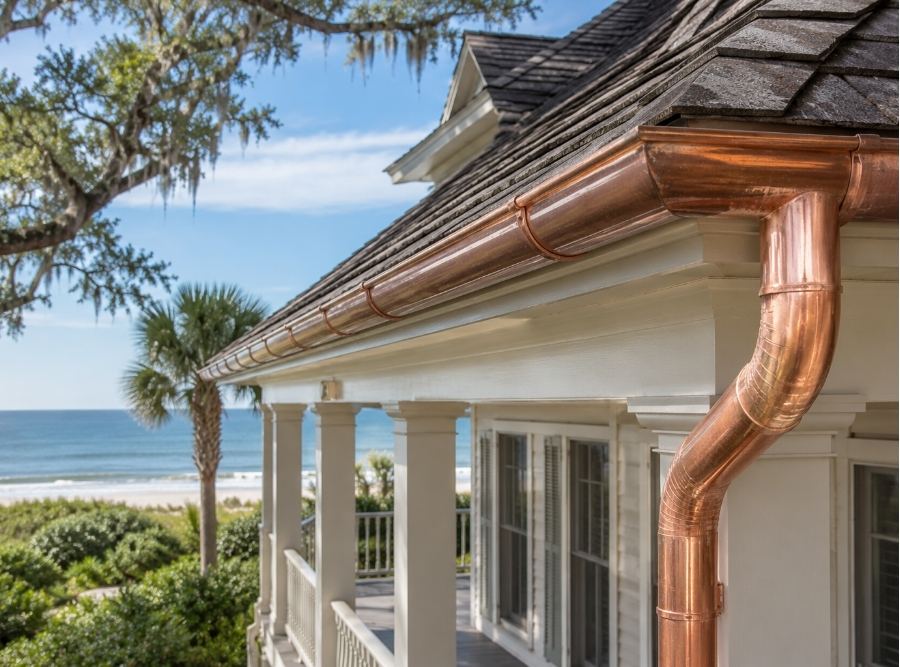
Are Copper Gutters Worth It Near the Ocean in Hilton Head, SC?
Yes, copper gutters can be worth it near the ocean in Hilton Head, especially for homeowners who want a long-lasting, architectural-grade gutter system that performs well in a coastal environment. Copper costs more upfront than standard aluminum, but its durability, natural patina, and resistance to typical rust problems can make it a strong long-term choice for oceanfront, marshfront, and luxury coastal homes.
Many Hilton Head homeowners start considering copper gutters after dealing with the same coastal maintenance cycle again and again. Standard gutters begin showing corrosion. Fasteners rust. Paint fades or peels. Seams start leaking. Before long, the system that looked fine a few years ago begins to feel worn out by the island’s salt air, humidity, and storm exposure.
That is usually when the question comes up: is copper actually worth the extra investment, or is it mostly about appearance?
The honest answer depends on the home, the exposure, the installation quality, and how long the homeowner plans to keep the property. Copper gutters are not the right choice for every house. However, for ocean-adjacent properties in Sea Pines, Forest Beach, Palmetto Dunes, Port Royal Plantation, Singleton Beach, and other coastal parts of Hilton Head, copper can offer a combination of durability, performance, and architectural character that standard systems often struggle to match.
Why Copper Makes Sense in a Coastal Environment
Hilton Head is hard on exterior building materials. Salt-laden air settles on metal surfaces throughout the year. Humidity keeps materials damp longer than they would be in a drier climate. Summer thunderstorms, tropical systems, wind-driven rain, and hurricane-season weather place added strain on gutter systems and their attachment points.
This matters because gutters are not just decorative trim. They are part of the home’s water-management system. When they fail, water can reach fascia boards, soffits, siding, landscaping, walkways, and foundation areas. In a coastal climate, where moisture already lingers, poor drainage can accelerate problems quickly.
Copper stands apart because it does not rust like steel. Instead, it naturally oxidizes and develops a patina over time. That patina changes the appearance of the gutter from bright copper to deeper brown tones and eventually to green or blue-green coloring, depending on the exposure. Many homeowners mistake that color change for corrosion damage, but in most cases, it is a normal protective surface layer rather than a sign of failure.
For coastal homes, that difference is significant. Copper still requires proper installation and maintenance, but the material itself is well suited for environments where ordinary components often age faster than expected.
Copper Is Not Just a Cosmetic Upgrade
One of the biggest misconceptions about copper gutters is that they are chosen only for looks. The appearance is certainly part of the appeal, especially on luxury homes, historic properties, and custom Lowcountry architecture. But copper’s value goes deeper than curb appeal.
For homeowners near the ocean, the bigger advantage is lifecycle performance. A lower-cost gutter system may be less expensive at installation, but if it requires more frequent repairs, hardware replacement, repainting, or full replacement, the long-term cost picture can change. Copper is often chosen by homeowners who are thinking in decades rather than just the immediate project price.
That said, copper is not magic. It can still develop seam issues, fastener problems, and attachment concerns if the system is poorly installed. The biggest difference is that when copper systems are properly designed and installed with compatible materials, the gutter material itself is usually not the weak point.
During inspections of coastal properties, actual problems with copper systems often appear around joints, hangers, fasteners, and incompatible metal connections rather than the copper trough itself. That is why the installation standard matters as much as the material choice.
What Homeowners Should Expect Copper to Look Like Over Time
Homeowners who choose copper should be prepared for the appearance to change. This is not a flaw. It is part of the material’s character.
Fresh copper begins with a bright, warm metallic finish. In Hilton Head’s coastal climate, that finish may begin darkening fairly quickly. Ocean-facing elevations may weather faster than protected areas. Shaded sections beneath live oaks or pine canopies may age differently from sunny rooflines. Marshfront homes may develop patina patterns at a different pace than homes farther inland.
This uneven aging can surprise homeowners who expected the system to maintain a uniform polished appearance. In reality, copper gutters near the ocean often develop a more varied look because they are responding to wind, salt, moisture, sunlight, and rainfall from different directions.
The green patina many homeowners ask about is usually not a failure indicator. It is part of the natural oxidation process. A copper system can look dramatically different after years of coastal exposure while still performing extremely well.
The key is knowing the difference between normal patina and true performance issues. Color change is expected. Active leaks, failing seams, loose hangers, incompatible metal corrosion, or water bypassing the system are concerns that deserve attention.
When Copper Gutters Are Most Worth the Investment
Copper gutters tend to make the most sense on homes where durability, architectural appearance, and long-term ownership value matter more than the lowest upfront cost.
That often includes oceanfront properties, marshfront homes, high-end custom residences, historic homes, and major renovations where the gutter system is expected to complement the overall architecture. In places like Sea Pines, Port Royal Plantation, Palmetto Dunes, Long Cove, Wexford, and ocean-adjacent parts of Forest Beach, homeowners often choose copper because they want a system that looks appropriate for the home while standing up to the coastal environment.
Copper may also make sense for homeowners who have already replaced or repaired standard gutters multiple times. If previous systems have struggled with corrosion, fastener deterioration, or early wear, copper can be part of a more durable long-term solution.
However, copper may not be the best investment for every property. A smaller inland home, a short-term ownership situation, or a budget-sensitive project may be better served by a high-quality aluminum system with appropriate coastal hardware and professional installation. The best material choice should always match the home, the exposure, and the homeowner’s goals.
The Installation Matters More Than Most People Realize
Copper gutters only deliver their full value when the entire system is designed correctly. This includes the gutter profile, downspout layout, soldered seams, hangers, expansion considerations, drainage capacity, and material compatibility.
One of the most important issues is avoiding incompatible metals. When copper comes into contact with the wrong materials in the presence of moisture, galvanic corrosion can occur. In a humid coastal environment like Hilton Head, that risk becomes more important because moisture is almost always part of the equation.
This is where shortcuts can become expensive. Using the wrong fasteners, mixing metals carelessly, or installing copper into an existing system without considering compatibility can create premature problems. Homeowners may blame the copper when the real issue is poor installation practice.
A properly installed copper gutter system should be viewed as an architectural drainage system, not simply a premium version of a basic gutter. It requires more planning, more care, and a better understanding of how coastal exposure affects every component.
What We Commonly See on Hilton Head Coastal Homes
One of the most common patterns we see is that homeowners become interested in copper after frustration with previous gutter systems. They may have dealt with rusted fasteners, chalky finishes, peeling coatings, repeated leaks, or premature aging on homes near the ocean. By the time they ask about copper, they are usually not just looking for a prettier gutter. They are looking for something they will not have to keep replacing.
Another common concern is whether copper will turn green too quickly. Near the ocean, it may develop patina faster than it would inland, especially on windward elevations exposed to salt air and moisture. But that appearance change is usually expected. The better question is whether the system is properly installed and still moving water away from the home effectively.
We also see homeowners compare copper and aluminum only by installation cost. That comparison misses the larger issue. On Hilton Head, the real comparison should include exposure level, maintenance expectations, corrosion resistance, architectural fit, hardware quality, and how long the homeowner expects the system to remain in place.
For the right property, copper is not just a luxury detail. It is a long-term material decision.
The Real Value Is Long-Term Water Management
The decision to install copper gutters should not be based on appearance alone. A beautiful gutter system that is undersized, poorly pitched, or incorrectly installed can still fail to protect the home. At the same time, a weathered copper system with a deep patina can continue performing beautifully for many years if it was designed and installed correctly.
This is the deeper point many homeowners overlook. The value of copper is not simply that it looks better than standard gutters. The value is that it can be part of a durable, long-life drainage system built for a demanding coastal environment.
Near the ocean, every exterior system has to be judged by how well it handles salt air, moisture, storms, and time. Copper earns its reputation because it can age with the home rather than simply wear out. It changes color, develops character, and responds visibly to the environment, but that transformation is often part of its strength rather than a warning sign.
For Hilton Head homeowners planning to stay in their property long-term, renovating a high-end coastal home, or replacing a system that has already struggled with corrosion, copper gutters can be a worthwhile investment. The key is making sure the system is designed for the home, installed with compatible materials, and evaluated as part of the larger goal: keeping water moving safely away from the structure.

Helder is the owner of GutterXperts, a family-owned seamless gutter company serving Bluffton, Hardeeville, Hilton Head Island, and the surrounding Lowcountry. He personally inspects every completed installation, and the team fabricates each gutter run on-site to match the exact roofline rather than using pre-cut sections. GutterXperts is licensed in South Carolina and Georgia and has served more than 500 homes throughout the region.