

Do I Need 6-Inch or 7-Inch Gutters for Heavy Rain in Bluffton, SC?
For most homes in Bluffton, properly designed 6-inch gutters are sufficient for handling heavy rainfall when paired with the correct number of downspouts and proper installation. However, larger homes, steep roof systems, metal roofs, and properties with significant roof valley runoff may benefit from upgrading to 7-inch gutters for additional drainage capacity during intense Lowcountry storms.
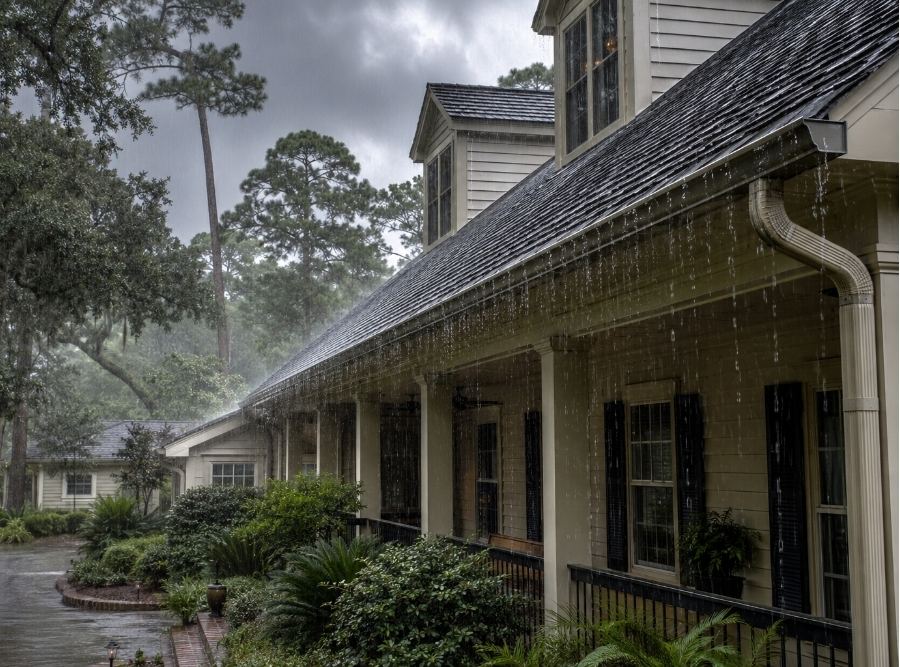
Every year, homeowners across Bluffton experience the same frustrating scenario. A heavy summer thunderstorm rolls through, rain begins falling in sheets, and suddenly water is pouring over the edge of the gutters like a waterfall. The gutters may have been cleaned recently, the downspouts appear to be flowing, and yet the system still seems overwhelmed. Naturally, many homeowners begin wondering whether their gutters are simply too small.
In Bluffton, that’s a reasonable question. The Lowcountry receives intense rainfall throughout the year, including powerful afternoon thunderstorms, tropical systems, and hurricane-season downpours that can push drainage systems to their limits. The answer, however, isn’t always as simple as choosing the largest gutter available. Determining whether a home needs 6-inch or 7-inch gutters requires looking at roof design, water volume, downspout capacity, and how rainwater actually moves across the property during severe weather.
Why Clean Gutters Can Still Overflow
One of the biggest misconceptions homeowners have is that overflowing gutters automatically mean something is clogged. While debris certainly causes drainage problems, many gutter systems overflow even when they’re completely clean.
The real issue is often capacity. Every roof collects rainwater and directs it toward the gutter system. During moderate rainfall, most systems function without difficulty. During a Bluffton thunderstorm, however, the amount of water leaving the roof can increase dramatically in a matter of minutes. If the roof is producing runoff faster than the gutter system can collect and move it away, overflow becomes unavoidable.
This is especially common on homes with large roof footprints, long gutter runs, steep roof pitches, and multiple roof valleys. In these situations, homeowners often spend years focusing on cleaning and maintenance when the real issue is that the drainage system is being asked to manage more water than it was originally designed to handle during peak rainfall events.
One of the clearest warning signs is when overflow occurs only during heavy storms. If the gutters perform well during normal rain but struggle during intense weather, capacity should be part of the conversation.
Understanding the Difference Between 6-Inch and 7-Inch Gutters
Many homeowners assume that one inch doesn’t make much difference in gutter performance. In reality, that additional inch can significantly increase how much water the system can collect and transport during severe weather.
A properly installed 6-inch gutter provides considerably more capacity than older 5-inch systems found on many homes. Throughout Bluffton, Okatie, Hampton Hall, Rose Hill, and New Riverside, 6-inch gutters have become the standard upgrade because they offer improved performance without dramatically changing the appearance of the home. For the majority of residential properties, they provide ample capacity when paired with properly sized downspouts and a well-designed drainage layout.
Seven-inch gutters serve a different purpose. These larger systems are often considered when a home has unusually large roof planes, extensive valley concentration, steep roof pitches, or metal roofing systems that shed water rapidly. The additional capacity provides a larger margin of safety during intense rainfall events, especially when large volumes of water are concentrated into specific sections of the gutter system.
What many homeowners don’t realize is that gutter width alone does not determine performance. A larger gutter attached to an undersized drainage system can still struggle during heavy rainfall. The entire system must work together to manage runoff effectively.
Why Roof Design Matters More Than Most Homeowners Realize
One of the most common things we discover during drainage assessments is that roof design often has a greater impact on gutter performance than gutter size alone.
A modest home with a simple roofline may perform exceptionally well with a properly designed 6-inch gutter system. Meanwhile, a larger custom home in communities such as Belfair, Berkeley Hall, Colleton River, or Palmetto Bluff may generate dramatically higher runoff volumes because of its roof geometry. Multiple roof levels, steep slopes, large roof planes, and complex architectural features can all increase the demands placed on the drainage system.
Roof valleys deserve particular attention because they act like funnels. Water from multiple roof surfaces is concentrated into one area before entering the gutter. During a heavy Bluffton thunderstorm, a single valley can discharge an enormous volume of water into a relatively short section of gutter. These concentrated runoff zones are often the first places where homeowners notice overflow.
Metal roofs can create similar challenges. Because water moves across metal surfaces more quickly than many traditional roofing materials, runoff reaches the gutter system faster and with greater intensity. In certain situations, larger gutters and upgraded downspouts may be necessary to accommodate that increased flow.
This is why there is no universal answer that every Bluffton home should have either 6-inch or 7-inch gutters. The right solution depends on how the roof collects and concentrates water.
The Overlooked Role of Downspouts
Homeowners naturally focus on the gutters because they are the most visible part of the drainage system. However, the gutter can only perform as well as its ability to move water out through the downspouts.
Think of the gutter as a holding area and the downspouts as the exit route. If water enters faster than it leaves, the system eventually becomes overloaded regardless of gutter size. We frequently inspect homes where larger gutters were installed but the original downspout configuration remained unchanged. The result is a drainage system that still struggles during heavy storms because the bottleneck was never addressed.
This is one reason why professional drainage evaluations look beyond gutter width. The number of downspouts, their location, their size, and the way they discharge water away from the home all influence overall performance. In some situations, adding additional downspouts can provide more benefit than upgrading to larger gutters.
Homeowners are often surprised to learn that a capacity problem may have less to do with the gutter itself and more to do with how efficiently water exits the system.
What We Commonly See on Bluffton Homes
Across Bluffton’s neighborhoods, we often encounter drainage systems that were sized for average weather rather than the kind of intense rainfall the Lowcountry regularly experiences. Builder-grade installations frequently perform adequately during normal conditions but reveal weaknesses during summer thunderstorms and tropical weather events.
One pattern we see repeatedly involves homeowners who have cleaned their gutters, installed gutter guards, and extended downspouts but still experience overflow during major storms. Because the gutters appear clean, they assume something else must be wrong. After inspection, the underlying issue often turns out to be insufficient capacity for the volume of water the roof is producing.
Another common situation occurs after a roof replacement. New roofing materials often shed water more efficiently than older roofs. Suddenly, runoff reaches the gutters faster than before, exposing limitations that were previously hidden. Homeowners are surprised to discover that the roof upgrade has changed how the entire drainage system performs.
The important lesson is that recurring overflow should never be dismissed as normal. Water repeatedly spilling over the edge of the gutter can contribute to fascia deterioration, siding stains, landscape erosion, foundation moisture concerns, and costly repairs that go far beyond the gutter system itself.
Bigger Gutters Aren’t Always the Answer—Better Water Management Is
When homeowners ask whether they need 6-inch or 7-inch gutters, they’re often focused on the visible symptom of the problem. The larger question is whether their home’s water management system is equipped to handle the realities of Bluffton’s climate.
For many homes, a properly installed 6-inch system with adequate downspouts provides excellent performance, even during heavy rainfall. For larger properties, steep roof designs, extensive valley runoff areas, and homes that repeatedly experience overflow despite proper maintenance, a 7-inch system may provide valuable additional capacity.
The goal isn’t simply installing the biggest gutter possible. The goal is creating a drainage system that safely captures, transports, and directs rainwater away from the home during the weather conditions Bluffton homeowners face every year. Understanding how water moves across the roof and through the drainage system is ultimately more important than focusing on gutter width alone.
If your gutters turn into waterfalls during every major storm, overflow even after cleaning, or struggle whenever tropical weather moves through the area, a professional drainage assessment can help identify whether the solution involves gutter sizing, downspout capacity, roof runoff concentration, or another design issue. In the Lowcountry, protecting your home starts with making sure your gutter system can keep up with the rain.

Helder is the owner of GutterXperts, a family-owned seamless gutter company serving Bluffton, Hardeeville, Hilton Head Island, and the surrounding Lowcountry. He personally inspects every completed installation, and the team fabricates each gutter run on-site to match the exact roofline rather than using pre-cut sections. GutterXperts is licensed in South Carolina and Georgia and has served more than 500 homes throughout the region.