

Downspout Installation in Bluffton, SC
When gutters overflow during Bluffton storms, the cause is often not the gutter itself but how water exits the system. Properly positioned downspouts move roof runoff away from the home instead of letting it back up in the trough and spill over the edge.
Where Drainage Problems Usually Start
Why a Clean Gutter Can Still Overflow During Bluffton Storms
When homeowners in Bluffton notice water pouring over the edge during storms, the gutter usually gets blamed first. Debris gets cleared, the trough gets checked, and the problem returns with the next heavy rain. In many cases, the gutter is not the issue, the exit point is.
Downspouts carry everything the roof collects safely to the ground. When there are too few, when they are poorly placed, or when they are undersized for the roofline, water backs up inside the trough before debris is ever the problem. Once the trough fills faster than the downspout can empty it, overflow begins.
We see this throughout Sun City, Buckwalter, and Belfair, where long rooflines sometimes drain toward a single downspout placed for convenience during original construction. During Bluffton’s heavier coastal storms, that layout often cannot move water fast enough.
A homeowner in Okatie recently contacted us because their gutter overflowed only in one section of the house. The gutter was properly installed and completely clear of debris. The entire back roofline was draining toward a single downspout. Adding a second downspout and slightly adjusting the slope of that run resolved the overflow entirely.
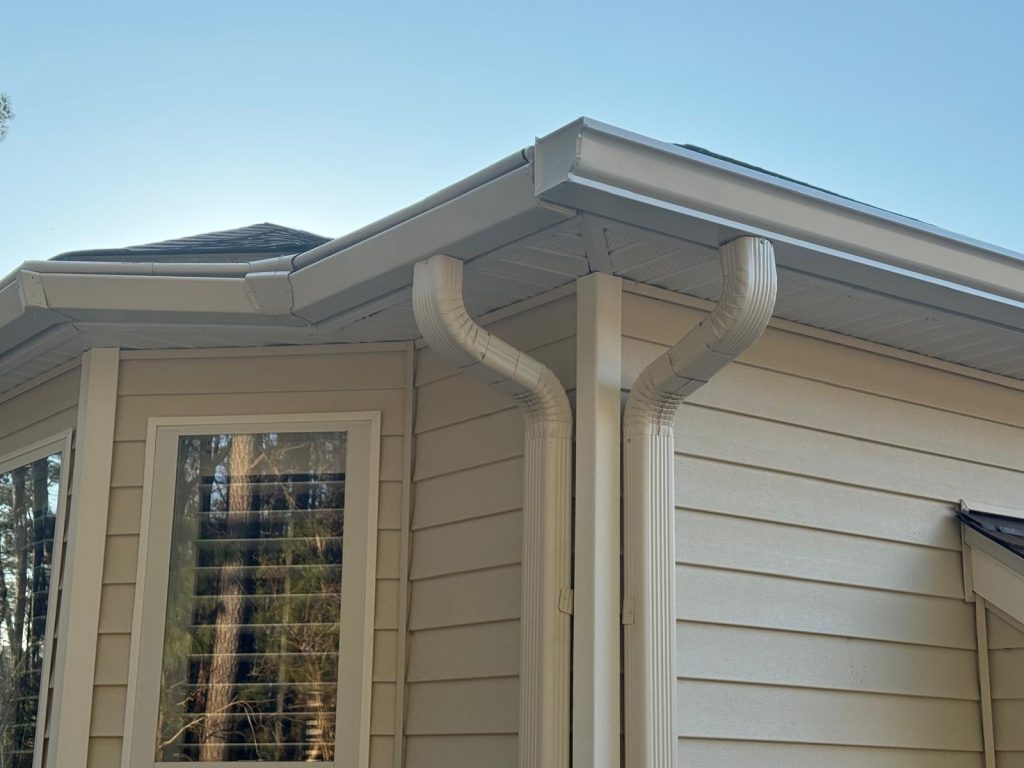
A gutter that fills faster than its downspout can empty it will always overflow, no matter how clean the trough is. The downspout is not a minor detail in the drainage system. It is what controls how quickly the whole system moves water.
How We Work
How We Install and Position Downspouts in Bluffton
Read the Roofline
Before installing anything, we study how water moves across the roofline, where it collects, and which sections carry the most volume. That helps us place downspouts based on drainage, not convenience.
Position for Proper Flow
Downspouts are placed where the gutter system collects the most water so the trough can drain continuously during storms. We also check that each downspout is properly sized for the roof area it serves.
Direct Water Away
After installation, we confirm the downspout sends water away from the house, not toward the foundation or nearby landscaping. When needed, we extend the discharge point to improve clearance and drainage.
★★★★★
“We had a great experience with Helder and Gutter Xperts. He was responsive, did the job on time, and the resulting work and the look was excellent. We purchased large seamless gutters and downspouts for our entire home. I recommend them highly.”
Paul B. – Bluffton, SC
Not Sure Whether You Need More Downspouts or Larger Ones?
Both problems produce the same symptom, the trough fills faster than it drains. Too few downspouts means the gutter is directing more water to an exit point than that point can handle. An undersized downspout means the pipe itself is the bottleneck. We identify which condition is present and explain the options before any work begins.
Call (843) 683-1676 and we will walk the gutter run and show you where the system is losing capacity.
What Undersized Exit Points Do Over Time
How a Drainage Bottleneck Damages the Rest of the Gutter System
When a downspout cannot empty the trough fast enough, the water that backs up exerts outward pressure on the gutter walls and inward stress on the hanger mounting points. Over repeated storms, that pressure causes hangers to loosen, seams to separate, and gutters to begin pulling away from the fascia. These issues often look like gutter problems but actually originate at the exit point.
In Bluffton neighborhoods like Palmetto Bluff and Buckwalter, where rooflines can be large and storm rainfall intense, a system with too few downspouts manages excess water every time a significant storm passes through. The gutter absorbs that stress throughout the season, and the damage accumulates in ways that only become visible after repeated exposure.
Correcting the downspout layout relieves that pressure at the source. Homeowners who add a downspout often find that other issues they attributed to normal gutter wear, such as slight sag in a mid run section or a seam that keeps opening, stabilize once the exit capacity matches the volume the roofline produces.
Gutter Services Available in Bluffton, SC
A gutter system only works as well as the components connected to it. A new gutter run won’t solve much if the downspouts still empty too close to the foundation. In those cases we often combine installation with gutter repair in Bluffton or adjustments to downspout placement so water actually exits the property. Some homeowners also choose to add gutter guards in Bluffton during the project, especially in areas where pine straw and oak leaves accumulate quickly.
The Full Drainage Path
How Rainwater Travels from Roof to Ground
Understanding how water moves through the full drainage system helps explain why downspout placement and sizing affects everything above it in the chain. Each step either passes water along efficiently or creates a point where the system can fail.

1. Rain falls on the roof and concentrates at the roofline
The pitch of the roof determines how quickly water moves and where it concentrates. Roof valleys, dormers, and wide flat sections direct different volumes of water toward specific points along the gutter. Homes with complex rooflines often have high-volume zones that a single downspout cannot handle alone.
2. Water enters the gutter and travels toward the downspout opening
The gutter’s slope, its pitch, determines how quickly water moves along the trough. A correctly pitched gutter moves water continuously toward the downspout without pooling in the middle of the run. Debris in the trough slows this travel, but even a clean gutter can back up if the exit is inadequate.
3. Water reaches the downspout, this is where the system’s capacity is tested
This is the controlling point of the entire drainage system. If the downspout is correctly sized and positioned for the volume arriving from the roof and gutter run, water exits cleanly. If it is undersized or there are too few, water backs up into the trough above. Everything that looks like a gutter problem in this scenario is actually an exit-point problem.
4. Water exits at ground level and moves away from the structure
Where the downspout terminates determines whether water actually leaves the property’s drainage zone. A downspout that exits against the foundation, or drains into a low spot adjacent to the house, can reverse the job the system was installed to do. Discharge direction is part of every installation we complete.
Common Bluffton Scenarios
Three Downspout Placement Problems We See Across Bluffton Neighborhoods
Downspout issues in Bluffton tend to follow recognizable patterns depending on when the home was built, the size of the roofline, and how the original system was designed. Knowing which scenario applies makes it faster to identify the right correction.
Long Roofline Draining to One Downspout
Common in Sun City, Belfair, and Buckwalter, where homes may have long rear rooflines draining into a single corner downspout. During heavy storms, the gutter fills faster than the one exit can handle. Adding a mid-run downspout splits the load and restores proper drainage without replacing the existing system.
Roof Valleys Directing Concentrated Flow into One Section
Roof valleys can funnel significantly more water into a short section of gutter than the rest of the roofline produces. When the downspout serving that section was positioned for aesthetics rather than drainage load, the system overflows consistently at that one location even when the trough is completely clear.
Builder-Installed Systems Designed for Average Rainfall
In newer communities like Okatie and Buckwalter, original gutter systems were sometimes specified for moderate rainfall volumes. As Bluffton’s heavier storm events push more water across those rooflines, the original downspout layout needs adjustment to match real drainage conditions rather than construction-phase estimates.
★★★★★
“Showed up on time, got the job done right, and the whole process was hassle free from start to finish.”
Aaron B, Bluffton, SC
Not sure which scenario applies to your home? Call (843) 683-1676 and we will walk the roofline and tell you what we find.
We Serve Bluffton & the Surrounding Lowcountry
Based in Bluffton, we work across the Lowcountry including Sun City, Belfair, Buckwalter, Hilton Head Island, Okatie, Beaufort, and the surrounding areas.
Why Downspout Placement Is Not Guesswork
What Goes Wrong When Downspouts Are Added Without Reading the Roofline
Adding a downspout in the wrong location can make drainage worse instead of better. If it is not placed where overflow is actually building, the pressure stays in the same section. The overflow continues, and the new connection can become a leak point if it is not tied in properly.
Downspout sizing matters too. A standard 2×3 downspout and a 3×4 downspout may look similar from the ground, but they handle very different water volumes. Using the smaller size on a large roofline section does not solve the problem.
Proper placement comes from understanding where roof water concentrates, how the gutter run is sloped, and how much volume the new downspout needs to handle during a storm. That is why the system should be assessed before any work begins. Call (843) 683-1676 and we will walk it with you.
Common Questions
Downspout Questions Bluffton Homeowners Ask
How many downspouts should a house have?
The number depends on roof size, slope, and how water concentrates across the roofline. A general guideline is one downspout for every 20 to 30 linear feet of gutter, but homes with large roof sections, steep pitches, or valley concentration points may need more. Roofline geometry matters more than a fixed ratio.
Can adding a downspout stop gutter overflow?
Yes, when overflow is caused by an exit capacity problem rather than debris. If the gutter is clean but still overflows in a specific location during storms, adding a downspout at or near that location is often the correct correction.
Why do my gutters overflow even after cleaning?
A clean gutter can still overflow if the downspout cannot empty the trough fast enough. The exit capacity of the system controls how quickly the trough clears during a storm, regardless of how much debris is or is not present.
Do downspouts need maintenance?
Yes. Debris can compact at the entry point where the downspout connects to the gutter, and over time leaves and sediment can reduce the interior diameter of the pipe. Confirming downspout flow is part of every cleaning and maintenance visit we perform.
Does it matter where the downspout ends at ground level?
Yes. The discharge point determines where water actually goes after it leaves the system. A downspout that terminates against the foundation, or that drains into a low spot adjacent to the house, can direct water toward the structure rather than away from it. We check discharge direction as part of every installation.
Schedule a Visit
Find Out Whether Your Downspouts Are Moving Water Away From Your Home
If your gutters overflow during storms or water collects near the foundation, call us and we will inspect the full drainage path. We will look at the roofline, evaluate the current downspout placement and sizing, and explain what corrections will help the system drain the way it was designed to.
GutterXperts | 2106 Okatie Hwy, Bluffton, SC 29909