

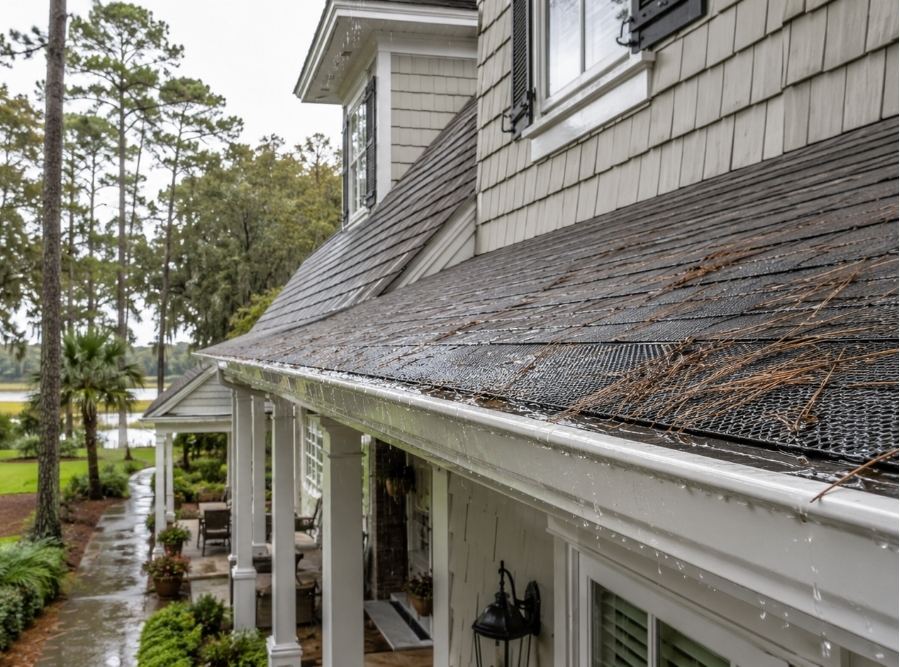
Do Micro-Mesh Gutter Guards Actually Stop Pine Needles in Bluffton?
Yes, micro-mesh gutter guards are one of the most effective options for reducing pine needle intrusion, but they do not completely eliminate maintenance. In Bluffton, SC, pine needles, organic debris, humidity, and heavy rainfall can still collect on top of the mesh over time, making periodic inspections and cleaning important for long-term performance.
Pine trees are part of what gives Bluffton its character. From the mature landscapes around Belfair and Berkeley Hall to the wooded buffers throughout New Riverside, Hampton Lake, Oldfield, and Palmetto Bluff, pine canopies are a common feature across the Lowcountry. Unfortunately, they also create one of the most persistent gutter maintenance challenges homeowners face.
Many homeowners invest in gutter guards hoping they will permanently solve pine needle problems. Then a heavy summer thunderstorm rolls through, and they notice pine straw sitting on top of the guards or water spilling over the edge of the gutter. It’s easy to assume the system has failed. In reality, the answer is usually more complicated. Micro-mesh gutter guards can dramatically reduce the amount of debris entering the gutter system, but understanding how they work—and their limitations—is essential for protecting your home from water damage.
Why Pine Needles Are Different From Other Gutter Debris
Most gutter protection systems are designed to manage common debris such as leaves, twigs, and seed pods. Pine needles create a different challenge entirely. Their thin shape allows them to collect tightly together, creating dense layers that behave differently than larger debris.
One of the most common things we observe during gutter inspections in Bluffton is that pine needles rarely cause problems one at a time. Instead, they accumulate in layers across the surface of the guard. Once mixed with pollen, roof grit, oak debris, and moisture, they can form a mat that restricts how quickly water enters the gutter. The gutter itself may remain relatively clean, but the surface above it becomes the bottleneck.
This issue is amplified by the local environment. Bluffton experiences long periods of humidity, frequent afternoon thunderstorms, and heavy seasonal rainfall. Pine needles that might dry and blow away in a drier climate often remain damp here, allowing additional debris to collect and decompose on top of the guard surface. Over time, that buildup can reduce performance even when the guard itself remains structurally sound.
How Micro-Mesh Gutter Guards Actually Work
Micro-mesh gutter guards use a fine filtration surface designed to allow water into the gutter while preventing debris from entering. Compared to traditional screens or larger-opening gutter covers, quality micro-mesh systems are generally much more effective at keeping pine needles, roof grit, and other small debris out of the gutter trough.
That distinction is important because the goal is not simply keeping debris off the roof. The purpose of a gutter protection system is to prevent material from entering the gutter where it can eventually clog downspouts and disrupt drainage. By blocking smaller debris before it enters the system, micro-mesh guards reduce the likelihood of hidden blockages that are difficult to detect until overflow occurs.
However, many homeowners misunderstand what the product is designed to do. Micro-mesh guards are filtration systems, not maintenance-elimination systems. Pine needles that land on the roof still need to be shed, blown away, or removed. The guard prevents them from entering the gutter, but it cannot make them disappear. That’s why even the best gutter protection systems perform best when they are periodically inspected, especially in heavily wooded areas.
The Biggest Misconception About Gutter Guards in Bluffton
The biggest misconception is that gutter guards eliminate maintenance entirely. This expectation often leads homeowners to believe something is defective when they notice debris accumulation or occasional overflow.
In reality, the best gutter guard systems are designed to reduce maintenance, not eliminate it. This is particularly true in Bluffton, where longleaf pines shed throughout much of the year and live oaks contribute additional organic debris. Homes near wooded preserves, golf course tree lines, and mature landscaping zones experience significantly higher debris loads than properties on open lots.
We’ve seen many situations where homeowners call because water is pouring over the front of the gutter during storms. They assume the downspout is clogged or the gutter guard has failed. After inspection, the actual issue is often a layer of pine straw and organic buildup sitting on top of the mesh surface. The gutter underneath remains relatively clear, but water cannot enter quickly enough during intense rainfall.
Understanding this distinction helps homeowners make better decisions. A properly functioning gutter guard can still require periodic cleaning while continuing to provide excellent protection against interior gutter clogs.
Why Some Micro-Mesh Systems Still Overflow During Heavy Rain
When overflow occurs, most people immediately focus on the gutter guard. However, gutter performance depends on the entire drainage system, not just the protective cover.
One common issue is surface loading. As pine needles accumulate on the mesh, they create resistance that slows water entry. During a light rain event, this may not be noticeable. During a strong summer thunderstorm or tropical weather event, however, roof runoff can arrive faster than water can pass through the partially obstructed mesh. The result is water overshooting the gutter rather than entering it.
Roof valleys often make the situation worse. Valleys collect water from multiple roof planes and discharge large volumes into concentrated sections of gutter. We frequently find that recurring overflow occurs beneath valleys because the volume of water hitting that specific section exceeds what the partially loaded mesh can process during peak rainfall.
Installation quality also plays a significant role. Poor gutter pitch, inadequate downspout placement, insufficient drainage capacity, and improperly designed water flow paths can all contribute to overflow. Homeowners often focus exclusively on the guard itself when the real problem involves the overall water management system.
This is why diagnosing gutter problems requires more than simply looking at the top of the guard. Understanding how water moves across the roof and through the drainage system is often the key to identifying the true source of the issue.
What We Commonly See on Bluffton Properties
Every area has its own drainage challenges, and Bluffton is no exception. Many of the homes we inspect throughout Hampton Hall, Rose Hill, Colleton River, Belfair, and New Riverside face a combination of mature tree cover and intense rainfall events. Those conditions place significant demands on gutter systems.
One pattern we see repeatedly involves homes where the gutter guard itself is performing reasonably well, but years of fine organic accumulation have gradually reduced water entry efficiency. Homeowners may not notice any issues during normal weather. Then a strong storm arrives, and suddenly water is cascading over the edge of the gutter in locations that have never overflowed before.
Another common observation involves homes with extensive pine coverage directly above roof valleys. These areas collect both concentrated runoff and concentrated debris. Even quality micro-mesh systems require more attention in these locations because the amount of water and organic material moving through the system is substantially higher than on other sections of the roof.
What makes these situations particularly important is that the visible overflow is often only the beginning. Water bypassing the gutter system can contribute to fascia deterioration, siding stains, landscape erosion, foundation moisture exposure, and other issues that become much more expensive than routine maintenance.
The Real Goal Isn’t Stopping Pine Needles
When homeowners ask whether micro-mesh gutter guards stop pine needles, they’re often asking a larger question. What they’re really trying to determine is whether the system will protect their home from the problems that unmanaged water can create.
The answer is that quality micro-mesh gutter guards are among the best available tools for reducing pine needle intrusion in Bluffton’s environment. They can significantly reduce debris entering the gutter system, lower the likelihood of hidden clogs, and improve long-term drainage performance. However, no gutter guard can completely eliminate the effects of heavy pine coverage, organic buildup, and Lowcountry weather.
The most successful gutter systems are the ones that combine quality products, proper installation, thoughtful drainage design, and periodic maintenance. When all of those elements work together, homeowners gain something far more valuable than clean gutters. They gain confidence that rainwater is being directed safely away from the home’s roofline, exterior surfaces, landscaping, and foundation.
If you’re noticing pine straw accumulating on your gutter guards, water overflowing during storms, or recurring drainage issues around your home, a professional inspection can help determine whether the issue involves debris buildup, roof runoff concentration, installation concerns, or another water-management problem. In Bluffton, protecting your home starts with understanding where the water goes after it leaves the roof.

Helder is the owner of GutterXperts, a family-owned seamless gutter company serving Bluffton, Hardeeville, Hilton Head Island, and the surrounding Lowcountry. He personally inspects every completed installation, and the team fabricates each gutter run on-site to match the exact roofline rather than using pre-cut sections. GutterXperts is licensed in South Carolina and Georgia and has served more than 500 homes throughout the region.