

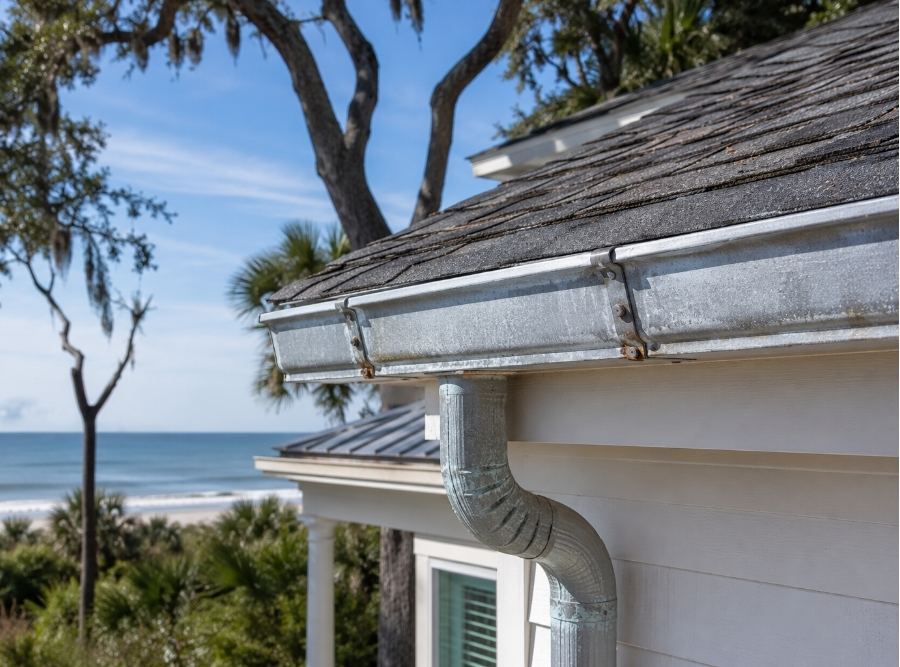
Why Do Gutters Fail Faster in Hilton Head’s Salt Air Climate?
Gutters often fail faster in Hilton Head because salt-laden air, high humidity, frequent rainfall, and coastal storms accelerate corrosion and wear on metal components. In many cases, the first parts to deteriorate aren’t the gutters themselves but the fasteners, hangers, seams, and attachment points that hold the system together.
If you’ve lived on Hilton Head Island for any length of time, you’ve probably noticed a pattern. Outdoor equipment seems to age faster here than it would inland. Hardware develops rust. Exterior fixtures weather more quickly. Metal components that might last for years elsewhere often require earlier maintenance or replacement.
Gutter systems are no exception.
Many homeowners are surprised when gutters that appear relatively new begin showing signs of deterioration. Paint starts peeling. Fasteners discolor. Rust stains appear beneath screws. Small leaks develop around seams. In some cases, sections begin pulling away from the house years sooner than expected.
The reason isn’t usually poor luck. It’s the environment. Hilton Head’s combination of salt air, humidity, storms, and year-round moisture exposure creates one of the most demanding conditions for exterior building materials in the Southeast. Understanding how that environment affects gutter systems can help homeowners make better decisions about maintenance, repairs, and replacement.
Salt Air Doesn’t Just Affect Oceanfront Homes
One of the biggest misconceptions homeowners have is that salt-related corrosion only affects homes directly on the beach.
While oceanfront properties in areas such as Sea Pines, Forest Beach, Palmetto Dunes, Port Royal Plantation, and Folly Field typically experience the most aggressive exposure, salt particles don’t stop at the shoreline. Coastal winds carry microscopic salt deposits throughout much of Hilton Head Island, where they settle on roofs, gutters, fasteners, and other exterior surfaces.
We’ve inspected gutter systems throughout the island and routinely find signs of salt-related deterioration well beyond beachfront neighborhoods. Homeowners often assume their property is far enough inland to avoid coastal corrosion, only to discover that the environment has been affecting their gutter system for years.
The difference is often a matter of degree rather than presence. Oceanfront homes usually experience the fastest deterioration, but virtually every gutter system on Hilton Head must contend with some level of salt exposure.
Why Salt and Moisture Are Such a Powerful Combination
Salt by itself isn’t usually the problem.
The real issue develops when salt particles combine with moisture. Hilton Head’s climate provides plenty of opportunities for that to happen. Humidity remains elevated throughout much of the year. Afternoon thunderstorms are common during the summer months. Coastal fog, heavy dew, and frequent rainfall keep exterior surfaces damp for extended periods.
As salt accumulates on metal surfaces, moisture activates the corrosion process. The resulting chemical reactions gradually break down protective coatings and accelerate oxidation. This process repeats itself over and over again through countless wet-dry cycles.
One of the reasons gutters struggle in coastal environments is that they rarely have an opportunity to remain completely dry for long periods. Even when it isn’t raining, humidity often leaves enough moisture behind to continue the corrosion process.
The result is a slow but persistent form of deterioration that affects nearly every exposed metal component.
The Parts That Usually Fail First
Many homeowners assume the gutter trough itself will be the first component to fail. Surprisingly, that’s often not what happens.
One of the most common observations we make during inspections is that the supporting hardware frequently deteriorates before the gutter material itself. Screws, hangers, downspout straps, attachment points, and fasteners often show signs of corrosion long before the main gutter sections experience significant damage.
This creates an important distinction. A gutter system can appear relatively healthy from the ground while critical structural components are quietly weakening behind the scenes.
We’ve seen situations where homeowners focus on minor cosmetic staining while hidden hanger corrosion is actively compromising the system’s ability to remain securely attached to the home. By the time sagging becomes visible, the problem has often been developing for years.
This is one reason routine inspections are so valuable in coastal environments. Many of the most important warning signs occur in areas homeowners rarely examine closely.
Why Some Gutters Age Faster Than Others
Not all gutter systems perform equally in Hilton Head’s climate.
Material quality, installation standards, drainage design, and hardware selection all influence how well a system withstands long-term exposure. Builder-grade systems often begin showing signs of wear sooner because they may utilize lower-grade fasteners, thinner materials, or components that were never intended for prolonged coastal exposure.
The environment surrounding the home also plays a major role. Properties exposed to prevailing coastal winds generally weather faster than homes protected by vegetation or neighboring structures. Marshfront properties often experience elevated moisture exposure. Homes beneath mature live oaks and pine canopies frequently retain moisture longer because debris traps water against the gutter system.
One pattern we repeatedly observe is that two neighboring homes can experience dramatically different aging rates based solely on their exposure conditions. A home positioned directly in the path of prevailing winds may show noticeable corrosion years before a more sheltered property nearby.
This is why there is no universal answer to how long gutters should last on Hilton Head. The environment surrounding each home matters tremendously.
What We Commonly See on Hilton Head Homes
One of the most frequent service calls begins with a homeowner saying something like, “These gutters shouldn’t look this old already.”
In many cases, they’re right. The gutters themselves may not be old by traditional standards. However, the coastal environment has accelerated the aging process beyond what homeowners expected when the system was installed.
Another common scenario involves recurring fastener problems. Homeowners replace a few screws, only to discover additional attachment points loosening months later. The issue isn’t necessarily the individual screw. The issue is often a broader pattern of hardware deterioration occurring throughout the system.
We also see many situations where corrosion is mistaken for purely cosmetic damage. Homeowners notice discoloration and assume it’s an appearance issue. After closer inspection, the corrosion has already begun affecting structural connections, seams, or drainage performance.
The challenge with coastal deterioration is that it rarely remains cosmetic forever. Left unaddressed, corrosion gradually transitions from appearance concerns to functional problems.
The Bigger Threat Isn’t Rust—It’s What Comes Next
Most homeowners focus on the visible signs of corrosion because they’re easy to spot. Rust stains, peeling paint, discoloration, and oxidation attract attention quickly.
The more significant concern is what happens after corrosion weakens the system.
As fasteners deteriorate, gutters can begin pulling away from the fascia. As seams weaken, leaks develop. As attachment points fail, sections become vulnerable during tropical storms and hurricane-force winds. Water begins reaching areas it was never intended to reach, including fascia boards, soffits, siding, landscaping, and foundation zones.
One of the most expensive mistakes homeowners make is assuming corrosion is merely an appearance issue. By the time water damage becomes visible, the underlying deterioration may have been developing for years.
This is why gutter inspections should focus on structural integrity rather than appearance alone. The goal isn’t simply maintaining attractive gutters. The goal is preserving a water-management system that continues protecting the home.
Hilton Head’s Climate Demands a Different Approach
Living on Hilton Head means accepting that exterior materials face challenges they wouldn’t encounter in many inland locations. Salt exposure, humidity, storms, and year-round moisture are simply part of the environment.
That doesn’t mean gutter systems are destined to fail prematurely. It does mean homeowners benefit from choosing materials, hardware, and installation methods designed specifically for coastal conditions. Regular inspections, proactive maintenance, and addressing small corrosion issues early can significantly extend the life of the system.
The reality is that gutters don’t usually fail because of a single storm or isolated event. Most failures result from years of environmental exposure gradually weakening components until the system can no longer perform effectively. Understanding that process helps homeowners recognize warning signs before minor corrosion becomes major damage.
If your gutters are showing rust stains, loose fasteners, recurring leaks, or signs of deterioration, the most important question isn’t whether the metal looks old. The most important question is whether the system is still protecting the home as intended. On Hilton Head Island, that’s the standard every gutter system ultimately has to meet.

Helder is the owner of GutterXperts, a family-owned seamless gutter company serving Bluffton, Hardeeville, Hilton Head Island, and the surrounding Lowcountry. He personally inspects every completed installation, and the team fabricates each gutter run on-site to match the exact roofline rather than using pre-cut sections. GutterXperts is licensed in South Carolina and Georgia and has served more than 500 homes throughout the region.