

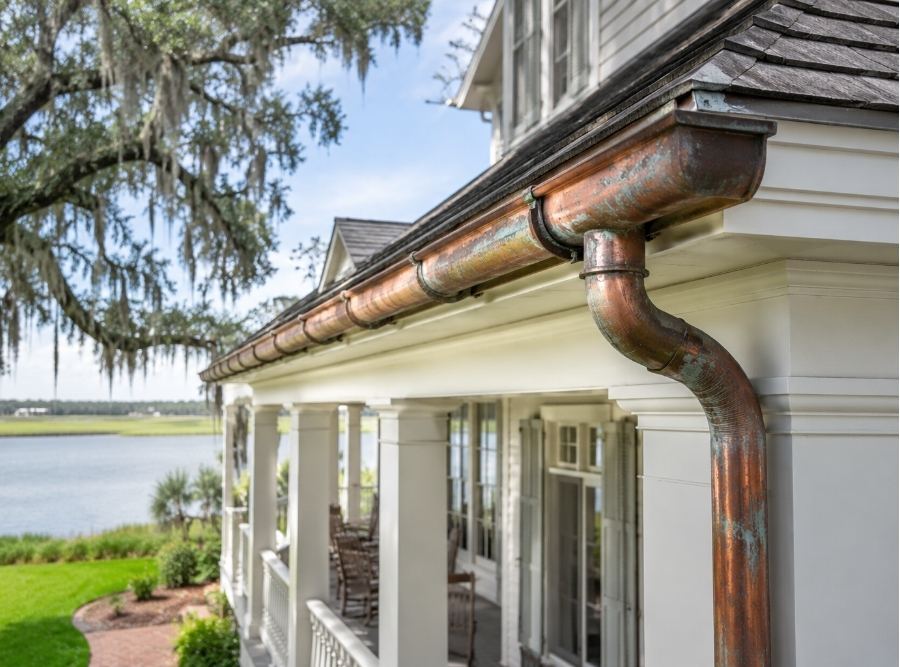
Will Copper Gutters Turn Green Faster or Corrode Near the May River?
Yes, copper gutters near the May River typically develop a green patina faster than copper gutters located farther inland. However, the green color is usually a natural protective layer rather than a sign of damage, and properly installed copper gutters can remain highly durable for decades even in Bluffton’s coastal environment.
Many homeowners choose copper gutters because they want something that offers more than simple functionality. Copper has a timeless appearance, complements Lowcountry architecture beautifully, and develops character as it ages. Whether it’s a custom home in Palmetto Bluff, a riverfront property overlooking the May River, or a historic residence near Old Town Bluffton, copper gutters are often selected because they add both craftsmanship and long-term value to the home.
Then the color begins to change.
The bright copper finish gradually darkens. Certain areas become brown while others develop green patches. River-facing elevations may weather differently than sheltered sections of the same home. Before long, homeowners start asking whether the coastal environment is damaging the gutters or causing them to deteriorate faster than expected.
The good news is that in most cases, what homeowners are seeing is not failure. It’s one of the reasons copper has remained one of the most respected architectural materials for centuries.
Why Copper Gutters Change Color Over Time
One of the biggest misunderstandings surrounding copper gutters is the belief that they are supposed to remain bright and shiny indefinitely. In reality, copper begins responding to its environment almost immediately after installation.
When first installed, copper has a warm metallic appearance that many homeowners find appealing. As the material is exposed to oxygen, moisture, rainfall, and airborne contaminants, it naturally begins to darken. Over time, those darker brown tones gradually evolve into the familiar blue-green patina often seen on historic buildings, churches, and older architectural features.
This process is known as oxidation, and it is entirely normal. Unlike steel, which can rust and weaken as corrosion progresses, copper develops a surface layer that actually helps protect the metal beneath it. The changing appearance often concerns homeowners, but the patina itself is typically a sign that the copper is doing exactly what it was designed to do.
Understanding this distinction is important because many service calls begin with cosmetic concerns rather than actual performance issues. The color may be changing, but that does not automatically mean the gutter system is deteriorating.
Why Copper Ages Faster Near the May River
While copper naturally develops patina in any environment, the process often occurs more quickly near the May River and other waterfront areas throughout Bluffton.
Properties overlooking the river, marshfront homes, and residences exposed to prevailing coastal winds experience a unique combination of environmental conditions. Moisture levels tend to be higher. Airborne salts are more common. Humidity remains elevated for much of the year. Frequent rainfall and tidal influences create conditions that encourage faster surface weathering than what is typically seen farther inland.
One pattern we consistently observe during inspections is that homes closest to the water often develop visible patina sooner than comparable homes in neighborhoods such as Buckwalter, New Riverside, or other inland sections of Bluffton. Homeowners sometimes assume the accelerated color change means the material is being damaged by salt exposure. In reality, the copper is often behaving exactly as expected within a coastal environment.
Even within the same property, weathering can occur unevenly. River-facing elevations may change color faster than protected sides of the home. Areas exposed to direct sunlight may develop differently than shaded sections beneath mature live oaks. Homes near marshes frequently experience different weathering patterns than properties surrounded by dense vegetation buffers.
These variations are a normal part of how copper responds to the environment around it.
The Green Color Most Homeowners Worry About
One of the most common questions we hear from homeowners is whether the green color means the gutters are corroding away.
The short answer is no.
Many people mistakenly refer to green copper as rust, but copper does not rust the way steel does. The green coloration is typically a patina layer formed through years of exposure to moisture, oxygen, and atmospheric conditions. Rather than weakening the metal, this layer acts as a protective barrier that helps shield the underlying copper from further environmental exposure.
During inspections throughout Bluffton, we often find that homeowners are far more concerned about appearance than performance. They point to green streaks, patchy coloration, or darkened sections and assume something must be wrong. Yet when the system is evaluated, the gutters remain structurally sound and continue directing water effectively away from the home.
The reality is that copper’s appearance changes much faster than its performance. A gutter system may look dramatically different after several years near the May River while remaining fully functional and structurally healthy.
This is one of the reasons copper remains a premium material despite its evolving appearance. The aging process is expected, and for many homeowners, it eventually becomes one of the material’s most attractive characteristics.
Where Real Problems Usually Begin
While the copper itself is rarely the first component to fail, that does not mean every copper gutter system is immune to problems.
One of the most valuable lessons we’ve learned from inspecting copper installations throughout the Bluffton area is that actual issues often originate somewhere other than the copper. Fasteners, hangers, soldered seams, attachment points, and areas where incompatible metals come into contact with the copper tend to require closer attention.
Galvanic corrosion is a good example. When dissimilar metals interact in the presence of moisture, one material can deteriorate more rapidly than intended. In these situations, homeowners may assume the copper gutter itself is failing when the real issue involves a fastener, bracket, or connection point elsewhere in the system.
We’ve also encountered situations where homeowners focus heavily on cosmetic patina while overlooking minor seam leaks or drainage concerns that deserve far more attention. A heavily weathered copper gutter can continue performing beautifully, while a shiny system with poor installation details may develop problems much sooner.
This is why professional installation matters so much with copper. The material itself is remarkably durable, but the long-term success of the system depends on every component being properly selected and installed.
What We Commonly See on Bluffton Riverfront Homes
Properties near the May River, Colleton River, and portions of Palmetto Bluff often provide some of the best examples of how copper evolves over time.
One of the most common service calls begins with a homeowner saying, “My copper gutters are turning green already. Is that normal?” In many cases, the gutters are functioning exactly as they should. The homeowner simply expected the bright copper finish to last longer before noticeable color changes appeared.
Historic homes near Old Town Bluffton tell a similar story. Many older copper installations have developed rich brown and green finishes that enhance the character of the property while continuing to perform reliably year after year. In these situations, the patina becomes part of the architectural identity of the home rather than something owners wish to remove.
What stands out most is that the homeowners who understand the aging process tend to appreciate copper more as time passes. Those who expect it to remain polished indefinitely often view normal weathering as a problem when it is actually one of the material’s defining characteristics.
The closer a property sits to tidal influences, moisture exposure, and river breezes, the sooner that transformation tends to become visible.
The Bigger Question Isn’t How Copper Looks
Many homeowners spend considerable time worrying about how quickly copper changes color, but appearance is often the least important indicator of gutter health.
A perfectly polished copper gutter that leaks at seams or fails to manage roof runoff creates far more problems than a heavily weathered system that continues directing water safely away from the home. The changing color naturally attracts attention because it is visible. Performance issues often remain hidden until water begins damaging fascia boards, siding, landscaping, or foundations.
This is where the conversation shifts from aesthetics to water management.
The real purpose of any gutter system is not preserving a specific appearance. The purpose is protecting the home from uncontrolled roof runoff. Whether the copper is bright, brown, or green, the question that matters most is whether the system continues performing its job effectively during years of rain, humidity, storms, and coastal exposure.
Copper’s Character Comes From the Environment Around It
One of the reasons copper remains such a sought-after material is that no two installations age exactly the same way. A home overlooking the May River will often develop a different appearance than a home farther inland. River breezes, moisture levels, tree cover, sunlight exposure, and coastal weather all influence the way the material evolves.
That transformation may happen faster than many Bluffton homeowners expect, but faster color change does not automatically mean faster deterioration. In most cases, the green patina people worry about is actually evidence that the copper is adapting to its environment and forming the protective surface layer that contributes to its long-term durability.
If you’re noticing green coloration, uneven weathering, or changes in appearance, the best approach is not to focus solely on the color itself. A professional inspection can help determine whether you’re seeing normal patina development or an actual issue involving seams, fasteners, drainage performance, or installation details. More often than not, the copper is simply doing what copper has done for generations—aging gracefully while continuing to protect the home beneath it.

Helder is the owner of GutterXperts, a family-owned seamless gutter company serving Bluffton, Hardeeville, Hilton Head Island, and the surrounding Lowcountry. He personally inspects every completed installation, and the team fabricates each gutter run on-site to match the exact roofline rather than using pre-cut sections. GutterXperts is licensed in South Carolina and Georgia and has served more than 500 homes throughout the region.