

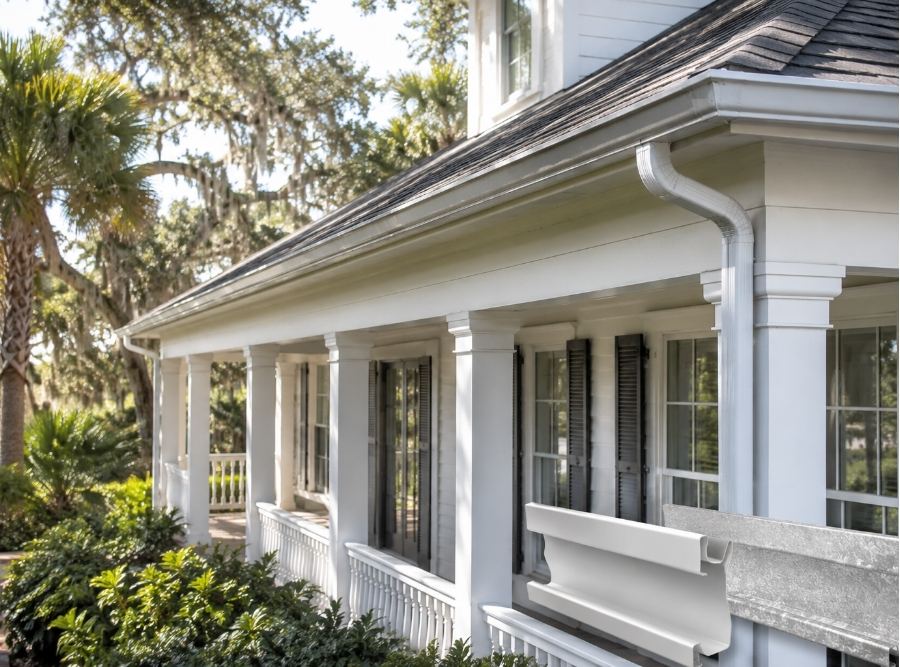
Is Galvalume Better Than Seamless Aluminum for Coastal SC Homes?
For most coastal South Carolina homes, seamless aluminum gutters are usually the better choice because they resist salt-air corrosion, require less maintenance, and offer strong long-term value in humid coastal environments. Galvalume gutters can be durable and strong, but near the coast, their performance depends heavily on protective coating integrity, proper installation, compatible hardware, and exposure to salt-laden air.
Homeowners in coastal South Carolina often start comparing gutter materials after seeing how quickly exterior metal can age near saltwater. Gutters that looked new a few years ago may begin showing chalky residue, rust-colored streaks, peeling finishes, loose fasteners, or leaks around corners. In areas like Bluffton, Hilton Head Island, Okatie, Palmetto Bluff, Sea Pines, Colleton River, and Palmetto Dunes, the environment can be harder on gutter systems than many homeowners expect.
That is why the question of Galvalume versus seamless aluminum matters. This is not just a product comparison. It is a question about how materials perform when exposed to salt air, high humidity, wind-driven rain, heavy thunderstorms, tropical systems, UV exposure, and year-round moisture. A gutter system that works well inland may not deliver the same long-term performance near the coast.
The honest answer is that both materials can work in the right situation, but seamless aluminum is usually the more practical choice for most residential coastal homes. Galvalume has strengths, especially when rigidity is important, but coastal exposure changes the calculation. The closer a home is to saltwater, marshes, or prevailing coastal winds, the more important corrosion resistance, drainage design, and installation quality become.
Why Coastal South Carolina Is So Hard on Gutters
Coastal South Carolina creates a demanding environment for any exterior drainage system. Salt-laden air settles on metal surfaces throughout the year, even on homes that are not directly on the ocean. Moisture from tidal waterways, marshes, summer thunderstorms, and long stretches of humidity keeps those surfaces damp longer than they would be in a drier inland climate. When salt and moisture work together, corrosion and finish deterioration can accelerate.
This is especially true in homes near Hilton Head, Bluffton, the May River, Port Royal Sound, Broad Creek, and surrounding marshfront areas. A property in Sea Pines or Forest Beach may experience more direct salt exposure than a home in New Riverside or Buckwalter, but the larger Lowcountry environment still creates elevated moisture and corrosion concerns across the region. Homes in golf communities, wooded neighborhoods, and waterfront areas often experience different aging patterns depending on wind exposure, tree cover, roof design, and maintenance history.
One of the most common mistakes homeowners make is assuming gutter failure comes from one single issue. In reality, coastal gutter problems usually develop from several conditions working together. Salt deposits weaken finishes. Humidity keeps debris damp. Pine needles and oak leaves trap moisture inside the system. UV exposure breaks down coatings. Heavy rain tests seams, hangers, and downspouts. Over time, small weaknesses become visible through stains, leaks, sagging sections, and fastener corrosion.
This is why choosing a gutter material for a coastal home should never be based on strength alone. The better question is how the entire system will hold up under years of salt exposure, moisture, rainfall, storms, and drainage demand.
Understanding Seamless Aluminum Gutters
Seamless aluminum gutters are widely used across Bluffton, Hilton Head, and the surrounding Lowcountry because they offer a strong balance of performance, corrosion resistance, appearance, and cost. Aluminum does not rust the way steel does, which gives it a major advantage in salt-air environments. It can oxidize over time, and finishes can fade or chalk with age, but it is far less likely to suffer the same rust-through concerns that affect steel-based products when protective coatings are compromised.
The seamless design is another major advantage. Seamless aluminum gutters are formed on-site in long continuous runs, which reduces the number of joints along the roofline. Fewer seams mean fewer places where leaks can develop, especially during heavy rain events. In a region where intense thunderstorms and tropical systems can move large volumes of water off the roof quickly, reducing weak points in the system matters.
During gutter inspections throughout coastal communities, many performance problems are not caused by the aluminum gutter body itself. More often, the issues involve installation details, loose hangers, undersized downspouts, improper pitch, clogged sections, or aging fasteners. That distinction matters because it shows why seamless aluminum remains a reliable choice when the system is installed correctly and matched to the home’s drainage needs.
For most residential homes, seamless aluminum provides the best blend of durability and practicality. It resists traditional rust, works well with custom rooflines, comes in a wide range of colors, and can be paired with proper downspouts and coastal-rated hardware for better long-term performance.
Understanding Galvalume Gutters
Galvalume is a steel product coated with an aluminum-zinc alloy designed to improve corrosion resistance. The steel core provides strength and rigidity, while the coating helps protect the underlying metal from exposure. This combination can make Galvalume a strong material in many building applications, especially when the coating remains intact and the system is installed correctly.
The challenge near the coast is that Galvalume’s performance depends heavily on the condition of that protective coating. If the coating is scratched, cut, worn, or compromised at edges, fasteners, seams, or connection points, the underlying steel can become more vulnerable. In a dry inland environment, that may be less concerning. In coastal South Carolina, where salt and moisture are constant factors, exposed steel can deteriorate faster than homeowners expect.
This does not mean Galvalume is a bad material. It can perform well in the right setting, especially where strength and rigidity are priorities. Certain homes, commercial properties, or specialty projects may benefit from the added stiffness of a steel-based product. However, homeowners should understand that Galvalume is not automatically better simply because it is stronger.
In coastal drainage work, longevity often depends less on raw material strength and more on how well the system resists corrosion, sheds water, avoids standing moisture, and protects vulnerable attachment points. A strong material with compromised coating can become a maintenance issue if the coastal environment finds its way to the exposed steel beneath.
The Common Misconception: Stronger Does Not Always Mean Better
Many homeowners assume that Galvalume must outperform seamless aluminum because steel sounds stronger than aluminum. That assumption makes sense on the surface, but gutter systems rarely fail because the trough material is not strong enough. More often, they fail because corrosion attacks hardware, seams begin leaking, pitch is wrong, water sits in low spots, or downspouts cannot move water away fast enough.
This is where coastal environments change the conversation. A material can be rigid and still be vulnerable if the coating breaks down. A gutter can feel heavy-duty and still fail at the fasteners. A system can look durable from the ground while hidden hangers are corroding behind the gutter line. In many coastal homes, the most important question is not which material is stronger, but which system will remain structurally sound and low-maintenance under years of salt, moisture, and storms.
Seamless aluminum often performs well because it avoids traditional rust and reduces leak-prone seams. Galvalume can perform well when the coating is protected, the fasteners are compatible, and the exposure level is appropriate. The problem is assuming that one material feature tells the whole story.
A well-installed seamless aluminum system can easily outperform a poorly installed Galvalume system. Likewise, a properly designed Galvalume system may serve certain properties well when the home’s exposure and maintenance expectations make sense. Material matters, but it is only one part of the decision.
What We Commonly See During Coastal Gutter Inspections
During gutter inspections in coastal South Carolina, one of the first things we look for is not just the condition of the gutter face. We look at the fasteners, hangers, seams, downspout straps, corners, outlet drops, and areas where moisture tends to linger. These parts often reveal the true condition of the system before the gutter body itself looks severely damaged.
On homes closer to Hilton Head’s oceanfront areas, such as Sea Pines, Forest Beach, Palmetto Dunes, Port Royal Plantation, and Singleton Beach, corrosion-related issues often show up around attachment points first. The gutter may still look acceptable from the ground, but screws, brackets, and hidden hangers may already be showing signs of wear. Once those components weaken, the gutter can begin sagging, pulling away from the fascia, or leaking during storms.
In Bluffton and Okatie communities farther from direct ocean exposure, the pattern can be different. Homes in Hampton Lake, New Riverside, Buckwalter, Sun City, or Rose Hill may not see the same level of salt exposure, but they still face humidity, heavy rainfall, tree debris, and long drying times. In those areas, the issue may be less about direct salt attack and more about standing water, pine needles, oak leaves, improper pitch, or fasteners aging in a damp environment.
Another common finding is that homeowners often blame the gutter material when the real problem is drainage design. A gutter system with too few downspouts, long runs without enough outlets, poor slope, or undersized capacity can fail regardless of whether it is aluminum, Galvalume, copper, or another material. Coastal homes need systems designed around water movement, not just material labels.
Which Material Makes More Sense Near the Ocean?
For homes closest to direct salt exposure, seamless aluminum usually has the advantage. Oceanfront and ocean-adjacent homes face constant environmental pressure from salt air, UV exposure, wind-driven rain, and moisture. In those settings, aluminum’s resistance to traditional rust gives it a practical long-term benefit.
This is particularly relevant for homes in areas like Sea Pines, Forest Beach, Palmetto Dunes, Port Royal Plantation, and Folly Field, where exterior materials are constantly exposed to coastal conditions. Seamless aluminum is not maintenance-free, but it tends to offer predictable performance when paired with proper installation, correct downspout placement, and quality hardware.
Galvalume can still be considered near the coast, but it requires more careful attention to coating protection, compatible fasteners, cut edges, and installation details. Any place where the coating is compromised can become a future concern. For some homeowners, that added vulnerability makes seamless aluminum the safer choice, especially when the goal is lower maintenance and long-term corrosion resistance.
The decision becomes less clear farther inland. In areas of Bluffton, Okatie, and other Lowcountry neighborhoods with reduced salt exposure, Galvalume may make more sense for certain applications. If a home has a large roofline, requires additional rigidity, or is located in a less aggressive exposure zone, Galvalume can be a reasonable option when installed properly. The location of the home matters just as much as the material itself.
What This Means for Bluffton and Hilton Head Homeowners
For most homeowners in Bluffton and Hilton Head, the right choice comes down to exposure, maintenance expectations, and long-term ownership goals. A homeowner with a beach-adjacent property who wants a low-maintenance gutter system will usually be better served by seamless aluminum. A homeowner farther inland with specific strength concerns may have more reason to consider Galvalume.
Vacation homes and rental properties deserve special consideration. These homes often go longer between inspections, and small gutter issues may not be noticed until they create visible damage. For property managers and second-home owners, lower maintenance and fewer corrosion concerns can be more important than small differences in installation cost. In those situations, seamless aluminum often becomes the more practical investment.
Homeowners planning to stay in their home long-term should also think beyond the initial quote. A gutter system that costs less upfront but requires more frequent repairs, hardware replacement, coating touch-ups, or early replacement may not be the better value over time. In coastal South Carolina, lifecycle cost often matters more than installation cost alone.
The best decision is rarely based on a material comparison in isolation. It should include the home’s distance from saltwater, roof size, drainage demand, tree coverage, downspout layout, fastener quality, and maintenance habits. That is how a homeowner moves from simply buying gutters to investing in a water-management system that actually protects the home.
Our Recommendation for Most Coastal SC Homes
For most residential homes along coastal South Carolina, especially in Bluffton and Hilton Head, seamless aluminum is usually the preferred gutter material. It offers strong corrosion resistance, reliable performance, fewer seams, broad design flexibility, and a practical cost-to-value balance. When installed correctly with proper pitch, adequate downspouts, and quality hardware, it performs well in the salt-air and high-humidity conditions that define the Lowcountry.
Galvalume is not automatically the wrong choice. It can be strong, durable, and appropriate for certain homes or commercial applications. However, in environments where salt exposure and moisture are major factors, the protective coating and installation details become critical. If those details are not handled correctly, the material’s advantages can be reduced over time.
The deeper point is that the best gutter system is not simply the one made from the strongest material. It is the one designed for the specific home, the specific roofline, and the specific coastal exposure. For many homeowners, that means seamless aluminum. For some, it may mean Galvalume or another premium option. The right answer starts with understanding where the water goes, how the environment affects the system, and what the home needs for long-term protection.
The Better Choice Is the System Built for the Coast
Galvalume and seamless aluminum can both have a place in gutter design, but coastal South Carolina rewards systems that are practical, corrosion-resistant, and thoughtfully installed. A gutter material may look strong on paper, but if it is not suited to salt air, moisture, roof runoff, and local storm conditions, it can become a source of repeated repairs.
For most Bluffton, Hilton Head, and Lowcountry homes, seamless aluminum provides the most dependable balance of performance and value. It resists rust, reduces seam-related leaks, and handles coastal exposure well when installed as part of a complete drainage plan. Galvalume can be worth considering in select situations, but it requires careful attention to coating protection and system design.
The goal is not simply choosing between two metals. The goal is protecting the home from uncontrolled water. Gutters exist to move rainwater away from fascia, soffits, siding, landscaping, walkways, and foundations. The best material is the one that helps the entire system keep doing that job year after year in the demanding coastal environment of South Carolina.
Helder is the owner of GutterXperts, a family-owned seamless gutter company serving Bluffton, Hardeeville, Hilton Head Island, and the surrounding Lowcountry. He personally inspects every completed installation, and the team fabricates each gutter run on-site to match the exact roofline rather than using pre-cut sections. GutterXperts is licensed in South Carolina and Georgia and has served more than 500 homes throughout the region.